
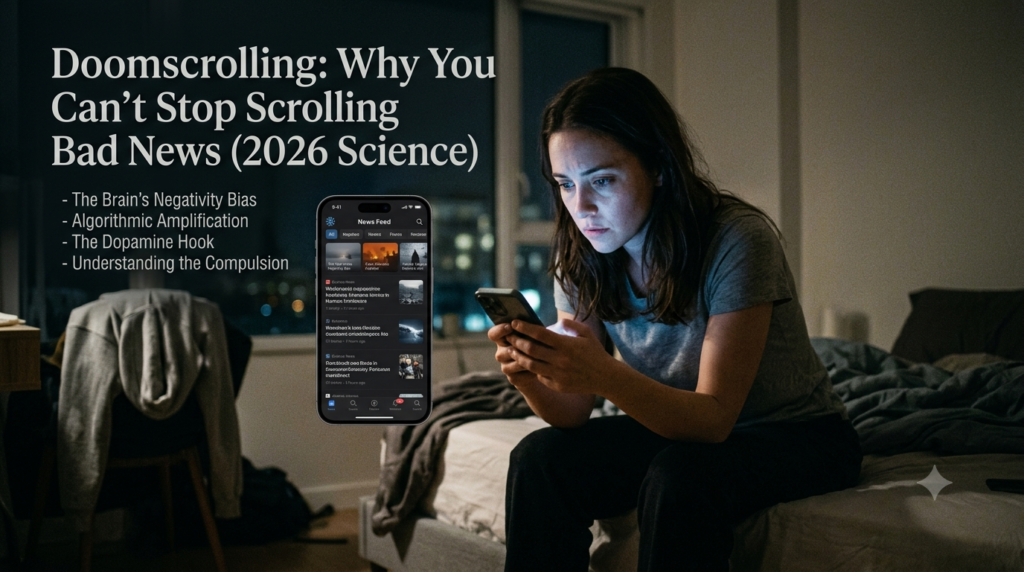
Mere doston, subah aankh khulte hi sabse pehle kya karte ho? Zyada tar log phone uthate hain aur seedha news ya Twitter/X pe chale jaate hain — earthquake, accident, politics ki ladai, koi na koi bura headline. Dil thoda bhaari ho jaata hai, phir bhi thumb rukta nahi, aur agla headline, aur agla. Raat ko sone se pehle bhi yahi cycle chalta hai.
Iska ek naam hai — doomscrolling. Aur 2026 ki fresh research ne is habit ko sirf ek “bad mood” tak seemt nahi rakha — isse ek measurable, growing public-health pattern maana ja raha hai jo neend, anxiety, aur overall mental wellbeing ko seedha affect karta hai. Aaj samjhte hain iske peeche ka science, aur isse todne ka practical raasta.
Table of Contents
1. What Is Doomscrolling?
Doomscrolling means compulsively consuming negative, distressing news or social content for extended periods, even when it makes you feel worse — and struggling to stop. The term became widely known during the pandemic years and has since moved from internet slang into serious academic research, with dedicated psychological scales now used to measure it.
Unlike Reels scrolling, which is driven mostly by novelty and entertainment, doomscrolling is driven by something older and deeper: your brain’s built-in threat-detection instinct.
2. How Big Is This Problem in 2026?
The numbers genuinely surprised me when I dug into them. Recent survey data suggests roughly a third of American adults regularly doomscroll, with the habit even more common among younger generations. A February 2026 release from the American Academy of Sleep Medicine found that a notable share of adults now prioritize screen time over getting a full night’s recommended sleep, with more than a third admitting their bedtime scrolling regularly delays sleep.
Globally, a large share of news consumers now say they actively avoid the news altogether because it feels overwhelming — a paradox where the same information that people compulsively scroll through is also making many of them want to disengage entirely.
3. The Shocking Science Behind the Compulsion
Here’s the mechanism, explained simply. Human brains evolved with a strong “negativity bias” — a threat-detection system that pays far more attention to danger, conflict, and bad news than to neutral or positive information, because in our evolutionary past, missing a threat was far costlier than missing good news. In today’s always-on news environment, this ancient wiring gets triggered constantly, and it doesn’t distinguish well between a genuine nearby threat and a distressing headline from the other side of the world.
Every alarming headline pulls your attention the same way a rustle in the bushes once did for your ancestors — except now, the “bushes” never stop rustling, day or night.
A 2024 study in Computers in Human Behavior Reports, involving 800 adults, found that doomscrolling is linked to heightened existential anxiety — a deep sense of dread tied to confronting life’s uncertainties — and that this anxiety further damages sleep quality. A separate review analyzing multiple studies with roughly 1,200 adults found consistent links between doomscrolling and lower overall wellbeing and life satisfaction.
4. What Doomscrolling Does to Your Brain and Body
Doctors sometimes describe the resulting sensation as “popcorn brain” — a real, biological feeling of being overstimulated from too much rapid online exposure, where your attention starts “popping” from one alarming thing to the next. A newer scoping review covering 17 empirical studies found consistent associations between doomscrolling and anxiety, depression, stress, and reduced psychological resilience, with rumination and emotional exhaustion identified as key underlying mechanisms.
Physically, the effects show up too — disrupted sleep, elevated stress responses, and for some people, a persistent low-grade sense of helplessness from information overload, where the sheer volume of distressing content makes it harder to process any of it clearly.
5. “Problematic News Consumption” — A New Clinical Framework
One of the most interesting 2026 developments is a proposed clinical framework called Problematic News Consumption (PNC) — describing a pattern of news engagement marked by preoccupation with news, difficulty regulating emotional reactions to it, and disruption to daily functioning. Recent research using this framework estimates a meaningful share of U.S. adults show signs of severe problematic news consumption, alongside a large global share who now actively avoid news because of how it makes them feel.
This matters because it reframes doomscrolling from “just a bad habit” into something closer to how researchers already think about problematic phone or social media use — which means the same behavioral-addiction tools that work for those (which we’ve covered in our dopamine detox guide) tend to help here too.
6. Signs You’re Doomscrolling Too Much
- The first and last things you do each day involve scrolling news or distressing content
- You feel a spike of dread but keep scrolling anyway
- You’ve lost track of time while scrolling negative news more than once this week
- You feel more anxious, hopeless, or on-edge after a scrolling session than before it
- You find yourself checking for updates on a distressing story every few minutes
- Family or friends have commented that you seem more tense or distracted lately
Curious how your overall phone habits stack up? Our phone addiction self-assessment test covers many of the same compulsive-use patterns.
7. How to Break the Doomscrolling Cycle
Step 1: Set specific “news windows.” Instead of checking news throughout the day, pick two fixed times — say 9 AM and 7 PM — and close the app once you’re done. This alone breaks the “always-on” trigger loop.
Step 2: Turn off news push notifications. Constant breaking-news alerts are one of the biggest doomscrolling triggers. Our guide to turning off phone notifications works well for this too.
Step 3: Create a hard cutoff before bed. Given how strongly bedtime scrolling is linked to poor sleep, treat the last 30-60 minutes before sleep as a genuinely news-free zone.
Step 4: Ask “can I act on this right now?” For most distressing headlines, the honest answer is no — and naming that out loud reduces the compulsive urge to keep refreshing for updates.
Step 5: Follow one trusted source, not ten. Constantly cross-checking multiple feeds for the same story amplifies anxiety without adding useful information. Pick one or two reliable sources and stop there.
Step 6: Balance the feed deliberately. Deliberately following a few genuinely positive or constructive accounts alongside news accounts has shown short-term mood benefits in early research — small, but a step in the right direction.
8. A Personal Note from oyebhaiya
Ek waqt tha jab main raat ko sone se pehle 30-40 minute sirf negative news scroll karta rehta tha — kabhi earthquake, kabhi accident, kabhi koi controversy. Neend to aati thi, lekin thodi restless. Jab maine “9 baje ke baad koi news nahi” wala rule banaya, farak turant dikha — dimaag zyada shaant feel hua sone se pehle. Aapko bhi try karna chahiye — chhota sa boundary, bada farak.
9. FAQ
Q1: What exactly is doomscrolling? Doomscrolling is the compulsive consumption of negative or distressing news and social content for extended periods, often continuing even when it clearly makes the person feel worse.
Q2: Is doomscrolling actually linked to anxiety and poor sleep, or is that exaggerated? No, it’s well documented — a 2024 study of 800 adults found doomscrolling linked to heightened existential anxiety and worse sleep quality, and a 2026 American Academy of Sleep Medicine release found a substantial share of adults regularly delay sleep due to screen use, much of it news-related.
Q3: Why can’t I just stop scrolling bad news even when I want to? Your brain has an evolved negativity bias that prioritizes threat-related information, and constant news exposure keeps this system chronically activated — making the urge to keep checking feel almost automatic rather than a simple lack of willpower.
Q4: What is “Problematic News Consumption” (PNC)? It’s a newer clinical framework describing a pattern of news engagement marked by preoccupation with news, poor emotional regulation around it, and disruption to daily life — treating severe doomscrolling similarly to other behavioral-addiction patterns.
Q5: What’s the single most effective way to reduce doomscrolling? Setting fixed “news windows” during the day and creating a genuinely news-free period before bed tend to produce the fastest, most noticeable improvements in both anxiety and sleep quality.
Also Read: If this resonated with you, you’ll probably also find value in our phone addiction self-assessment test, our dopamine detox guide for beginners, and our guide to turning off phone notifications for deep focus.
Thank you so much for providing such informations
Thankyou for ur feedback, Keep reading and sharing good post