
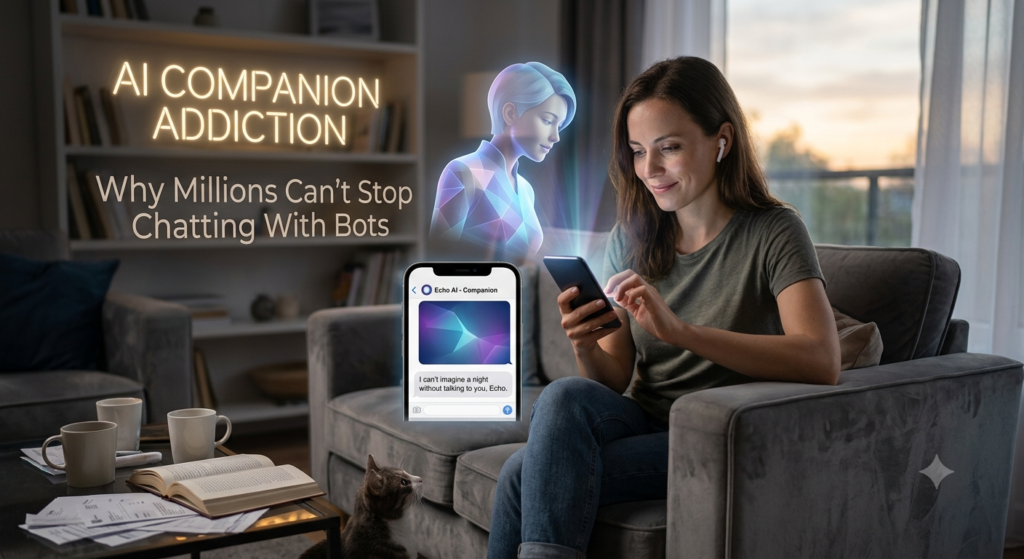
AI Companion Addiction Mere bhaiyo ek naya trend dekha maine — log ab Instagram ya YouTube pe nahi, apne AI chatbot se ghanton baat karte hain. Kuch log usse apna “best friend” bulate hain, kuch usse apni problems share karte hain jo shayad kisi insaan ko bhi nahi batate. Sunne mein sweet lagta hai, lekin research kehti hai ki ye ek naya, bahut hi tricky kism ka addiction ban raha hai — aur ye humari Reels ya WhatsApp wali addiction se bhi alag tarah kaam karta hai.
Aaj hum baat karenge AI chatbot/companion addiction ki — kya ye sach mein real hai, science kya kehti hai, aur agar aap ya aapka koi apna ChatGPT, Character.AI, ya kisi bhi AI companion pe bahut zyada depend ho gaya hai, toh kya karein.
Table of Contents
1. What Is AI Chatbot Addiction?
AI chatbot addiction refers to a compulsive, emotionally dependent pattern of use where someone relies on an AI companion — like Replika, Character.AI, or a general assistant used conversationally — to the point that it disrupts sleep, real-world relationships, or daily functioning. Unlike Reels or Instagram, where the addictive pull comes from novelty and dopamine spikes, AI companion addiction tends to be built on something deeper: emotional attachment.
Researchers studying this describe it using the same framework used for behavioral addictions generally — conflict, mood modification, tolerance, withdrawal, relapse, and salience (the AI relationship becoming disproportionately important in someone’s life).
2. The Numbers: How Big Is This Trend?
This isn’t a fringe phenomenon anymore. Since ChatGPT’s release in late 2022, AI chatbot adoption has scaled faster than almost any consumer technology in history, reaching very large user bases within months rather than years. Current estimates suggest a majority of American teenagers now regularly use AI companion apps, and usage has shifted meaningfully — early adoption centered on productivity tasks, but emotional support and companionship have now become one of the dominant reasons people keep coming back.
Surveys also show a large share of adults now use AI chatbots regularly, with a notable portion reporting daily use — a pattern researchers are watching closely because of how quickly it has scaled compared to previous “screen addiction” waves like social media.
3. The Shocking Research: What 2026 Studies Found
A 2026 Drexel University study, presented at the CHI Conference on Human Factors in Computing Systems, analyzed how teenagers themselves talk about their AI chatbot use online — and found that their own descriptions matched all six recognized components of behavioral addiction: conflict, withdrawal, mood modification, tolerance, relapse, and salience. Teens in the study reported disrupted sleep, academic struggles, and strained real-world relationships tied directly to their chatbot use.
Separately, new 2026 research from the University of British Columbia, presented at the same conference, points to a specific design factor driving this: AI chatbots can instantly fulfil almost any request — a supportive friend, a romantic partner, an assistant who never disagrees — with essentially zero effort, and this “genie-like” quality appears to be part of what fuels compulsive use. Some users in this research reported severe physical symptoms, including chest tightness and anxiety when unable to access their chatbot, alongside sleep loss and reduced real-world social interaction.
The American Psychological Association’s 2026 survey of over 1,200 licensed psychologists found that more than a third of them now have patients turning to AI chatbots as an additional, sometimes unsupervised, source of mental health support — and while over half of psychologists agreed chatbots could help reduce loneliness in principle, the overwhelming majority also said AI companionship could negatively affect users’ broader social engagement.
4. Why AI Companions Are Uniquely Addictive
Reels hook you through unpredictability and novelty. AI companions hook you through something different — validation. A chatbot can be endlessly patient, endlessly agreeable, and available at 3 AM when no human is. It never gets bored of you, never judges, and can be shaped conversationally to say exactly what feels good to hear.
That’s precisely what makes it risky. Real relationships involve friction, disagreement, and compromise — all things that build resilience. An AI companion, by design, can remove all of that friction, which researchers worry may make ordinary human relationships feel comparatively more effortful and less rewarding over time, echoing the same dynamic seen with short-form video and the “TikTok Brain” effect.
5. Signs of Unhealthy AI Chatbot Attachment
- You’d rather message your AI companion than talk to a friend or family member about something difficult
- You feel genuine anxiety or distress when you can’t access the chatbot
- Conversations with the AI have started replacing sleep, study, or work time
- You’ve hidden or downplayed how much you use it from people close to you
- You feel more understood by the chatbot than by people in your actual life
- Real conversations increasingly feel slower, more effortful, or less satisfying by comparison
If several of these sound familiar, it’s worth pausing and taking stock — not with shame, but with the same practical mindset we use for any other screen habit. Our phone-addiction-test quick phone addiction self-assessment is a good starting point, since many of the same underlying patterns overlap.
6. It’s Not All Bad — What Research Also Shows
To be fair to the technology, Praveen ke doston, the picture isn’t one-sided. Some controlled studies have found AI companions can genuinely reduce feelings of loneliness for certain users, and one large study of student Replika users found a small but meaningful group who said the chatbot helped stop suicidal thoughts during a difficult moment — a reminder that this technology can act as a real support for people in acute distress.
A major MIT Media Lab and OpenAI study also found that for most casual users, heavy chatbot use wasn’t automatically harmful — the negative effects (loneliness, reduced socializing) were concentrated specifically among a smaller group who had emotionally intense, personal conversations with their chatbot rather than casual or task-based use. In other words: how you use it seems to matter more than how often.
7. How to Keep AI Use Healthy
Step 1: Notice what you’re using it for. Task-based use (writing help, learning, planning) shows very different risk patterns than using it purely for emotional companionship or validation.
Step 2: Set a “humans first” rule. If something difficult is on your mind, try telling one real person before opening the chatbot — even a short message to a friend.
Step 3: Watch your sleep and time boundaries. If chatbot conversations are creeping into your sleep window, that’s an early, reliable warning sign worth acting on immediately.
Step 4: Reset your baseline occasionally. A short structured break works the same way it does for any other digital habit dopamine detox guide applies well here too.
Step 5: Be extra careful with teenagers in the house. Given how strongly the 2026 research points to teen vulnerability, keep conversations open at home about how AI companions are being used — curiosity, not surveillance, works best. Our family digital detox guide has practical, non-confrontational ways to start this conversation.
Step 6: If distress feels serious, involve a real professional. AI chatbots are not a substitute for licensed mental health support, especially during a genuine crisis — a real therapist or counsellor should always be the first call in that situation.
8. A Personal Note from Praveen
Maine khud try kiya AI chatbot se casual baatein karna, aur ek cheez notice ki — ye kabhi bore nahi hota, kabhi disagree nahi karta, hamesha “sahi” jawab deta hai. Shuru mein achha lagta hai, lekin dheere dheere realize hua ki asli dost ke saath jo thoda friction, thodi bahas hoti hai, wahi toh relationship ko real banati hai. Ab main isse ek useful tool ki tarah use karta hoon — kaam ke liye, seekhne ke liye — lekin emotional baatein apne asli logon se hi karta hoon. Balance hi key hai, yaar. AI Companion Addiction
9. FAQ
Q1: Is AI chatbot addiction a recognized medical condition? Not yet as a formal clinical diagnosis, but 2026 research from institutions like Drexel University and the University of British Columbia has found that heavy AI companion use can display all six recognized components of behavioral addiction in some users.
Q2: Are AI companions always harmful? No — research is mixed. Some studies show AI companions can reduce loneliness or even help during acute distress for certain users, while other studies link heavy, emotionally intense use to increased loneliness and reduced real-world socializing. The effect appears to depend heavily on how the AI is used.
Q3: Are teenagers more at risk of AI chatbot addiction? Yes, current research specifically flags teenagers as a higher-risk group, with a 2026 study finding widespread teen use accompanied by concerns about unhealthy attachment, disrupted sleep, and academic struggles.
Q4: What’s the healthiest way to use AI chatbots? Using them primarily for task-based purposes (learning, planning, writing help) rather than as a primary emotional support system, setting time and sleep boundaries, and keeping real human relationships as the first place you turn during difficult moments.
Q5: When should someone seek professional help instead of relying on an AI chatbot? Any time distress feels serious, persistent, or involves thoughts of self-harm — an AI chatbot should never replace a licensed mental health professional, and reaching out to one should always come first in a genuine crisis.