
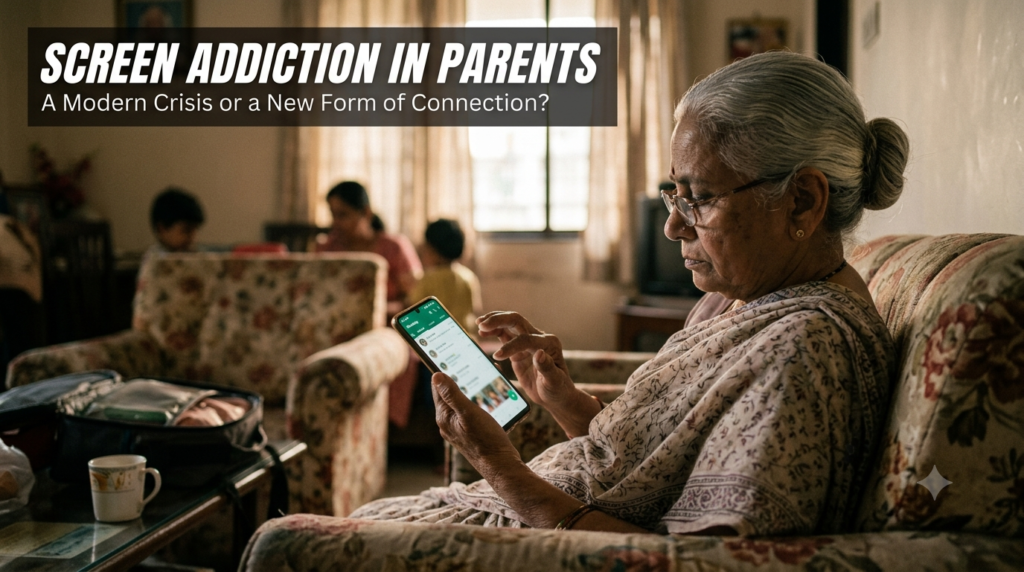
Oyebhaiya ke readers, aaj baat karenge Digital Detox for Parents, hum aksar bachchon ki screen addiction ki baat karte hain — lekin ek cheez jo bahut kam log discuss karte hain, wo hai apne hi parents aur dadi-nani ki phone ki aadat. Kabhi socha hai ki papa dinner table pe bhi Reels dekh rahe hain, ya mummy raat ko 12 baje tak family WhatsApp group mein “Good Morning” wale forwards bhej rahi hain?
Ye koi chhota mazaak wala topic nahi hai — ye ek genuine, badhta hua phenomenon hai jo poore Bharat ke ghar-ghar mein ho raha hai. Aaj hum dekhenge ki humare parents aur grandparents mein screen addiction kaise develop hoti hai, iske peeche kya reasons hain, aur ek caring family member ki tarah hum kya kar sakte hain — bina unhe embarrass kiye ya disrespect kiye.
Table of Contents
1. Yes, It’s Real — Screen Addiction in Older Indians (Digital Detox)
Multiple recent accounts describe the same pattern: a parent buys a smartphone for a genuinely useful reason — tracking daily steps, staying in touch with a grandchild abroad, following the news — and within months, the phone becomes something closer to a constant companion. One widely shared account describes a father whose phone became an extension of his arm after he started using it just to track his daily 10,000 steps.
This isn’t really surprising once you consider how much time some seniors now spend on screens. Reported daily screen time among some older Indian users runs close to eight hours — comparable to, or even higher than, the screen time many parents worry about in their own children.
2. Why This Happens: The Loneliness Connection (Digital Detox)
Here’s the part that genuinely changes how you should think about this, Praveen ke doston. This usually isn’t about entertainment addiction the way it is for teenagers scrolling Reels. For many older adults, it’s about loneliness. Nearly half of Indian elders associate ageing with loneliness, and with joint-family living arrangements shrinking and children moving to different cities or countries, the phone has become one of the few remaining bridges to the outside world.
Video-calling a grandchild abroad, following family updates on WhatsApp, or simply keeping YouTube running in the background just to avoid silence in an empty house — these aren’t random habits. They’re coping mechanisms for a very real, very human problem: isolation. Understanding this changes the entire approach — this isn’t a discipline problem the way it might be with a teenager; it’s often an emotional need being met the only way currently available. However Digital Detox is necessary.
3. The WhatsApp Forward Problem
If your family WhatsApp group is anything like most Indian households, you already know this one well — good morning images, health tips of dubious origin, festival wishes, and political commentary, all arriving in a steady stream throughout the day. This pattern is common enough in India that people jokingly call it “WhatsApp University” — a nickname for the sheer volume of unverified forwards, from medical advice to conspiracy theories, that circulate daily among Indian users.
The habit itself can become compulsive — checking the group repeatedly, feeling obligated to forward messages onward, and measuring social connection through forward counts and group activity, which closely echoes the group-related anxiety we covered in our WhatsApp group anxiety piece. Hence, Digital Detox is mandatory.
4. Scam and Misinformation Vulnerability
This is the part that worries me most as a family member, not just as a blogger. Indians lost over ₹22,000 crore to cyber fraud in a recent year according to government data, and UPI-related fraud alone crossed ₹800 crore in just eight months of one financial year — with more than half of victims not even reporting the incident, meaning the real numbers are likely higher still.
Older adults answering unknown numbers because “it might be important,” combined with a general trust in whatever arrives on WhatsApp from a known contact, makes this demographic a specific target for OTP fraud, fake bank calls, and increasingly convincing AI-generated voice and video scams. This isn’t a reflection of intelligence or capability — it’s a mismatch between a trust-based communication style built over decades and a threat landscape that has changed dramatically in just the last few years. Digital Detox
5. Signs Your Parent or Grandparent May Be Struggling
- Phone is checked or held even during meals, conversations, or family time
- Irritability or defensiveness when asked to put the phone down
- Forwarding messages rapidly without pausing to verify them first
- Falling for or nearly falling for a scam call, fake offer, or suspicious link
- Screen time noticeably higher than it was even a year or two ago
- Using the phone specifically to avoid silence or being alone
6. How to Help — Without Disrespecting Them
Step 1: Lead with curiosity, not correction. Asking “what have you been watching lately?” opens a conversation. Announcing “you’re addicted to your phone” usually just triggers defensiveness — the same reverse-psychology instinct that worked on us as kids tends to work here too.
Step 2: Address the loneliness directly. If the underlying driver is isolation, the real fix isn’t taking the phone away — it’s creating more real-world connection. A weekly video call at a fixed time, a regular in-person visit, or connecting them with a local senior citizens’ group or walking club can reduce the pull of the phone far more effectively than any restriction.
Step 3: Build gentle media literacy together. Rather than dismissing every forward, sit with them occasionally and check a claim together using a quick search. Over time, this builds their own instinct to pause before forwarding, without ever making them feel talked down to. Digital Detox
Step 4: Protect them from scams practically. Save “known scam patterns” as a simple note they can refer to, enable spam-call blocking on their phone, and make it completely normal for them to call you first before acting on anything urgent-sounding — a bank message, a prize claim, a family emergency request for money.
Step 5: Create one shared phone-free ritual. A daily meal or a Sunday evening walk with a “phones stay in the other room” rule works well precisely because it’s shared, not imposed — everyone in the family follows the same rule, so it never feels like a punishment aimed at them specifically.
Step 6: Take your own phone addiction self-assessment test first. Genuinely worth doing before having this conversation — it’s much easier to guide a parent gently when you’ve honestly checked your own habits too.
7. A Personal Note from Oyebhaiya
Meri khud ki maa ko maine dekha hai — pehle sirf calls ke liye phone use karti thi, ab poora din YouTube pe bhajan aur news chalti rehti hai, chahe wo dekh rahi ho ya nahi. Shuru mein mujhe laga ye normal hai, lekin jab maine gently poocha “aap kyun lagatar chalu rakhti ho,” unhone kaha “ghar mein sannata lagta hai.” Us din samajh aaya ki ye addiction nahi, akelapan hai. Ab hum roz shaam ek chhoti si walk karte hain — phone ghar pe hi rehta hai. Farak choti si baat se aaya, lekin genuine hai. Digital Detox ho rha hai.
8. FAQ
Q1: Is screen addiction in older adults different from addiction in teenagers? Yes, in an important way — while teen screen addiction is often driven by novelty and social validation, screen habits in many older adults are more closely tied to loneliness and a shrinking real-world social circle, especially as joint-family living arrangements have become less common.
Q2: Why do parents and grandparents forward so many WhatsApp messages without checking them? This pattern, sometimes jokingly called “WhatsApp University,” reflects a combination of low media literacy around digital content, a trust-based communication culture, and high emotional engagement with forwarded content — not a lack of intelligence or care.
Q3: Are elderly Indians actually more vulnerable to online scams? Yes — reported cyber fraud losses in India have crossed ₹22,000 crore in a recent year, and older adults are frequently targeted specifically because of a tendency to answer unknown numbers and trust WhatsApp content from known contacts.
Q4: What’s the best way to talk to a parent about their phone use without upsetting them? Leading with curiosity rather than correction works far better than direct criticism — asking what they’re watching or reading, rather than announcing that they’re “addicted,” tends to open a real conversation instead of triggering defensiveness.
Q5: What actually helps reduce screen time in older adults long-term? Addressing the underlying loneliness — through regular calls, in-person visits, or local community groups — tends to work far better than restricting phone access, since for many seniors the phone is currently their main bridge to feeling connected.
Also Read: If this topic resonates with your family, you may also find our family digital detox guide, our WhatsApp group anxiety guide, and our phone addiction self-assessment test helpful for the whole household, not just the older generation.
The Nod Mag — “Our parents, aka Gen X and Boomers, get more screen time than our kids”: https://thenodmag.com/content/gen-x-boomers-social-media-instagram-reels-youtube-addiction-screen-tim EcoSocioSphere — “‘WhatsApp University’ – The Misinformation Crisis in India”: https://ecosociosphere.in/whatsapp-university-the-misinformation-crisis-in-india/
Digital Detox