
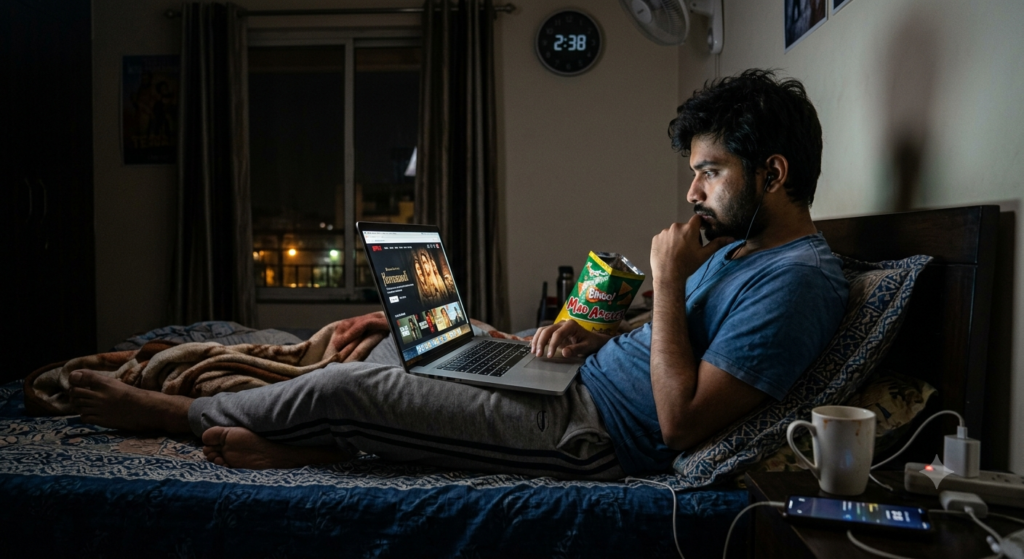
Oye Bhaiya ka ek sawaal — “sirf ek episode aur dekhta hoon” bolke aap kitni baar poora season khatam kar chuke ho? Netflix pe “Are you still watching?” ka message aaye, aur aap bina soche “Yes” pe click kar dete ho, raat ke 2 baj chuke hote hain, subah office/college hai, phir bhi ek aur episode chal jaata hai.
Ye sirf aapke saath nahi ho raha, yaar. India mein log duniya mein sabse zyada OTT content dekhte hain — average daily streaming time yahan global average se kaafi zyada hai. Aur khud sarkar ki Economic Survey 2026 ne bhi binge-watching ko crore logon ki “de facto habit” bataya hai. Aaj hum dekhenge ye addiction kaise kaam karti hai, iske health effects kya hain, aur balance kaise banaye rakhein.
Table of Contents
1. What Is Binge-Watching Addiction?
Binge-watching means consuming multiple episodes of a show, or an entire season, in one extended sitting — and binge-watching addiction is when this pattern becomes compulsive, disrupts sleep or daily responsibilities, and continues despite the person wanting to cut back. Researchers now formally categorize problematic OTT use alongside other behavioral addictions like gaming and social media, since it shows the same recognizable pattern: loss of control, continued use despite consequences, and withdrawal-like restlessness when unable to watch.
The term itself was officially added to the Collins English Dictionary back in 2015 — a sign of how quickly this became a mainstream, universally recognized habit rather than a niche behavior.
2. How Big Is This in India? The Numbers
The scale here is genuinely striking. Reports on teen and young adult OTT usage have found India topping global charts with an average daily usage of roughly 8 hours 29 minutes, compared to a global average closer to 6 hours 45 minutes — meaning young Indians spend nearly two extra hours a day on streaming content compared to their global peers. Separately, a widely cited industry study found that nearly half of India’s youth spend 2-3 hours a day specifically binge-watching, with millennials and Gen Z averaging around four hours of total OTT consumption daily.
This isn’t a fringe habit anymore either — it’s now recognized at the highest policy level. India’s Economic Survey 2026 specifically flagged digital addiction as a key challenge, noting that binge-watching on platforms like Netflix and Prime has become a genuine default habit for millions of young Indians, alongside social media and gaming.
3. The Shocking Research on OTT Addiction
A study published in the Journal of Family Medicine and Primary Care, surveying medical college undergraduates in Odisha, found OTT addiction prevalence at a striking 68.37% among participants — meaning more than two-thirds of the students studied showed signs of problematic streaming use. The same research found OTT addiction was significantly linked to poorer physical health, poorer mental health, and preferred late-night watch times specifically.
A broader systematic review and meta-analysis covering 39 separate studies found consistent links between binge-watching and depression, poor sleep, anxiety, stress, and loneliness — and importantly, these connections appeared to strengthen further during periods of social isolation, suggesting binge-watching and loneliness can feed into each other in a cycle. Other research has specifically found that problematic binge-watchers frequently sacrifice sleep to fit in “just one more episode,” and tend to feel a genuine sense of unhappiness or emptiness when a season or series ends — sometimes called “post-series depression” in casual conversation, though it reflects a real, documented emotional dip.
4. Why Streaming Platforms Are Built to Be Unstoppable
This isn’t accidental, Oye Bhaiya. Autoplay-next-episode, cliffhanger endings deliberately placed at the end of nearly every episode, and entire seasons released at once specifically to enable binge-viewing are all conscious platform design choices — the same “friction removal” strategy used by short-video apps, just applied to long-form content instead. Every design decision is aimed at removing the natural stopping point a weekly TV episode used to give you.
This connects directly to what we covered in our guide on how screen addiction affects your sleep — bingeing late at night is one of the most common and damaging patterns, precisely because “one more episode” keeps pushing bedtime later without you consciously deciding to stay up.
5. Signs Your Binge-Watching Has Crossed a Line
- You regularly stay up far later than planned specifically because of “one more episode”
- You’ve cancelled or postponed real plans to keep watching a show
- You feel restless, empty, or low after finishing a season — not just the story ending, but genuinely losing your evening routine
- Work, study, or household responsibilities have slipped noticeably because of streaming time
- You’ve lied about or downplayed how much you’ve been watching
- Sitting through a single, unhurried episode feels harder than powering through several in a row
6. How to Watch Without Losing Control
Step 1: Turn off autoplay. Every major platform allows this in settings. Removing the automatic “next episode in 5 seconds” countdown restores the natural pause point that TV scheduling used to give you for free.
Step 2: Decide episode count before you start, not during. Deciding “two episodes tonight” before pressing play works far better than deciding in the moment, when the pull to continue is strongest.
Step 3: Set a hard bedtime cutoff. Given how strongly late-night bingeing damages sleep, treat 30-45 minutes before your actual bedtime as a genuinely screen-free buffer, not “just one more.”
Step 4: Watch socially when you can. Research suggests some of the loneliness-binge-watching cycle comes from solitary viewing specifically — watching with family or friends occasionally, even the same show separately with a WhatsApp discussion afterward, changes the emotional dynamic significantly.
Step 5: Notice the “post-series slump.” If you feel low after finishing a show, that’s a documented, normal reaction — plan something specific for that evening in advance (a call with a friend, a walk) rather than immediately starting another series to fill the gap.
Step 6: Do an occasional reset. Our dopamine detox guide for beginners applies well here too, since binge-watching activates very similar reward pathways to social media and gaming.
7. A Personal Note from Praveen
Ek baar maine ek poori web series raat mein hi khatam kar di thi — subah 5 baje so paya, aur poora din bilkul thaka hua feel hua. Us din realize hua ki “sirf ek episode aur” wala jaal kitna real hai. Ab main autoplay off rakhta hoon aur khud se pehle hi decide kar leta hoon kitne episode dekhne hain. Farak choti si baat se aaya, lekin genuine hai — ab shows enjoy bhi zyada hoti hain, kyunki guilt nahi hota.
8. FAQ
Q1: Is binge-watching addiction a real, recognized condition? While not yet a formal standalone clinical diagnosis, researchers increasingly study problematic OTT use using the same behavioral-addiction framework applied to gaming and social media, given the similar patterns of loss of control and continued use despite negative consequences.
Q2: Is India really the highest binge-watching country in the world? Reports on teen and young adult streaming habits have found India recording the highest average daily OTT usage globally, at roughly 8 hours 29 minutes compared to a global average of about 6 hours 45 minutes.
Q3: What are the biggest health risks linked to binge-watching? A large meta-analysis of 39 studies found consistent links between heavy binge-watching and depression, poor sleep, anxiety, stress, and loneliness, with a study of Indian medical students separately finding significant impacts on both physical and mental health.
Q4: Why do I feel sad or empty after finishing a show? This is a documented reaction sometimes informally called “post-series depression” — research has found viewers frequently report unhappiness or a sense of loss when returning to reality after an intense binge-watching session.
Q5: What’s the single most effective change to reduce binge-watching? Turning off autoplay tends to have an outsized effect, since it restores a natural decision point before each new episode instead of relying on willpower to actively stop a countdown that’s already started.