
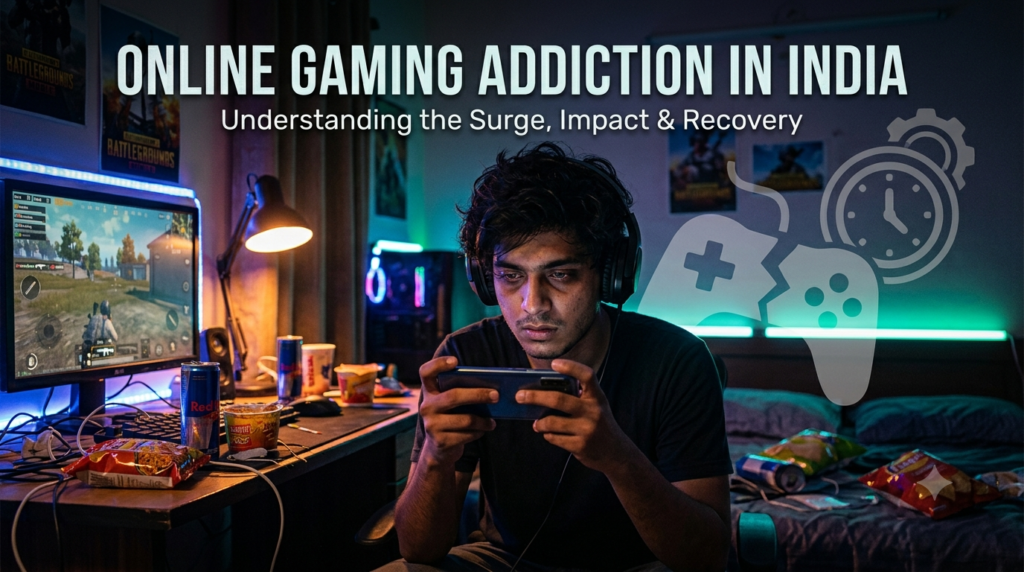
Oyebhaiya ke readers, aaj ka topic thoda alag hai — aur bahut zaroori bhi. Aapne shayad news mein suna ho ki is saal India ne apne online gaming rules poori tarah badal diye hain. Lekin asli sawaal ye hai — kya inn rules se aapke ghar ka bachcha jo raat 2 baje tak BGMI ya Free Fire khel raha hai, safe ho jaayega? Chaliye samajhte hain.
2026 mein India ka gaming market kaafi bada ho chuka hai, aur sarkar ne khud ise ek public health concern maan liya hai — sirf entertainment ka masla nahi raha. Aaj hum dekhenge naye rules kya kehte hain, gaming addiction asal mein kya hota hai, aur agar aapke ghar mein koi excessive gaming kar raha hai toh kya karna chahiye.
Table of Contents
1. What Changed: The New 2026 Gaming Rules Explained
On May 1, 2026, India’s Promotion and Regulation of Online Gaming (PROG) Rules came into force, built on the back of a law passed by Parliament in August 2025. These rules created a completely new regulator, the Online Gaming Authority of India (OGAI), and drew a firm line: online money games — anything involving real cash stakes, whether based on skill, chance, or a mix of both — are now prohibited outright. Esports and online social games, on the other hand, can continue and even get formal government support.
Crucially, the rules also introduced what’s officially called “user safety features” — age verification, time restrictions to limit excessive play, parental controls, user reporting tools, and even counselling support for addiction-related concerns, all required to be disclosed by gaming companies upfront.
2. Why the Government Stepped In
This didn’t come out of nowhere. India’s own Economic Survey 2025-26 directly flagged digital and gaming addiction as a threat to the country’s “demographic dividend” — the idea that India’s huge young population could become a growth engine only if that generation stays mentally healthy, focused, and able to self-regulate. The Survey pointed to some striking figures: internet connections in India jumped from 250 million in 2014 to nearly 970 million by 2024, and Indians collectively spent an almost unbelievable one lakh crore hours on smartphones in just 2024 alone.
India’s online gaming user base itself has grown to roughly 488 million players, and even a small percentage of problematic use at that scale becomes a genuine national concern — which is exactly the language the government has used while introducing these rules.
3. Is Gaming Addiction a Real Medical Condition?
Yes — and this is something a lot of Indian parents don’t realize. The World Health Organization’s ICD-11 (the official global diagnostic manual) formally recognizes “Gaming Disorder” as a real behavioral addiction, alongside things like gambling disorder. Indian psychiatry formally adopted these same criteria in 2024.
The diagnostic picture involves three core things continuing for 12 months or longer (or as little as 6 months if severe): impaired control over how much or how often someone games, gaming taking increasing priority over daily life — displacing sleep, meals, hygiene, school, or work — and continuing to game despite clear negative consequences. Indian psychiatrists currently estimate that roughly 6-8% of adolescent gamers meet full diagnostic criteria, with boys aged 13-19 the most vulnerable group.
4. What the New Rules Actually Cover (and Don’t)
Here’s the important nuance, Praveen ke doston: the 2026 rules are, at their core, a financial regulation. They’re extremely effective at protecting people from losing real money on predatory gambling-style platforms. But the broader, more everyday issue — a child playing a free social or esports-style game for six, eight, ten hours a night, sleep completely reversed, grades slipping, withdrawing socially — sits almost entirely outside what these rules directly control.
This matters because it means the responsibility for that everyday kind of gaming addiction still falls heavily on families, not just regulation. The rules give platforms new safety obligations, but they don’t replace parental awareness at home.
5. Warning Signs of Gaming Addiction in Children and Teens
Based on the clinical criteria and patterns Indian psychiatrists are now seeing, here are the red flags worth watching for:
- Playing 6+ hours on weekdays or 10+ hours on weekends, consistently
- Strong aggression or irritability when asked to stop or take a break
- Lying about time spent gaming, or hiding devices from family
- Skipping school or college classes, or grades dropping noticeably within a few months
- Losing interest in offline friendships and hobbies they once enjoyed
- Sleep reversal — awake through the night, sleeping through much of the day
- Spending unusually large amounts on in-game purchases, sometimes without a parent’s knowledge
If several of these feel familiar, it’s worth having an honest, non-confrontational conversation rather than an immediate confrontation — panic tends to push kids toward hiding the behavior further.
6. Why Regulation Alone Isn’t Enough
It’s worth learning from other countries here. China’s strict gaming-time limits for minors are a useful cautionary tale — research shows that when one platform gets restricted, screen time often just shifts elsewhere rather than actually reducing. Kids moved from gaming apps to short-video platforms instead, which isn’t really progress for overall digital wellbeing.
This is exactly why the same underlying skills we’ve discussed for reels and social media apply here too — regulation can restrict specific platforms, but building genuine self-regulation and healthy digital habits at home is what actually reduces total unhealthy screen time, not just moves it around.
7. What Families Can Do Right Now
Step 1: Have the conversation early, not after a crisis. Talk openly about how games are designed — progressive reward tiers, loot boxes, and constant milestone tracking are deliberately built to keep players hooked, similar to gambling mechanics.
Step 2: Use the new safety features actively. Since platforms are now required to offer parental controls and time restrictions, actually turning these on is a simple, concrete first step many families skip.
Step 3: Watch sleep first. Sleep reversal is one of the earliest and clearest warning signs — protecting bedtime hours matters more than restricting total daily minutes.
Step 4: Build a broader digital wellness routine, not a single ban. A full household approach — covered in our family digital detox guide — tends to work far better than banning one app in isolation.
Step 5: Reset the household’s overall relationship with screens. Our dopamine detox guide for beginners applies well here too, since gaming activates very similar reward pathways to social media and short-video addiction.
Step 6: Know when to seek professional help. If gaming has clearly disrupted school, sleep, or family relationships for months, a child psychiatrist or counsellor experienced in behavioral addiction is worth involving — this isn’t something willpower alone usually fixes.
8. A Personal Note from Praveen
Meri padosi ke bete ki kahani sunkar mujhe laga ye topic likhna zaroori hai — raat ko 2 baje tak game khelta tha, subah school ke liye uthna mushkil ho jaata tha, aur dheere dheere marks bhi girne lage. Uske parents ne shuru mein phone hi cheen liya, lekin usse gussa aur bhi badh gaya. Jab unhone baat karna shuru kiya — “kyun khelte ho, kya achha lagta hai usme” — tabhi jaake asli progress hui. Rules important hain, lekin ghar ki baatcheet utni hi zaroori hai.
9. FAQ
Q1: What exactly do India’s new 2026 Online Gaming Rules ban? They ban online money games entirely — any game involving real cash stakes, whether based on skill, chance, or a combination of both — while allowing esports and online social games to continue under new registration and safety requirements.
Q2: Is gaming disorder a real, officially recognized condition? Yes. The WHO’s ICD-11 formally classifies Gaming Disorder as a behavioral addiction, and Indian psychiatry adopted the same diagnostic criteria in 2024, with symptoms needing to persist for 12 months (or 6 if severe).
Q3: Do the new government rules protect kids from gaming addiction in general? Only partially. The rules are primarily a financial regulation aimed at money-based gambling-style games. Everyday gaming addiction involving free or social games — excessive hours, disrupted sleep, declining grades — largely remains a family responsibility rather than something the rules directly control.
Q4: What are the earliest warning signs of gaming addiction in a child? Sleep reversal (staying up gaming through the night), strong irritability when asked to stop, declining grades, and loss of interest in previously enjoyed offline activities tend to appear before things become severe.
Q5: Will restricting one gaming app solve the problem? Not usually. Evidence from other countries, including China’s gaming restrictions for minors, shows that screen time often simply shifts to another platform rather than genuinely reducing — building broader self-regulation habits at home tends to work better than a single-app ban.
Also Read: If you found this useful, our family digital detox guide, our dopamine detox guide for beginners, and our phone addiction self-assessment test cover related ground that many parents find helpful too.