
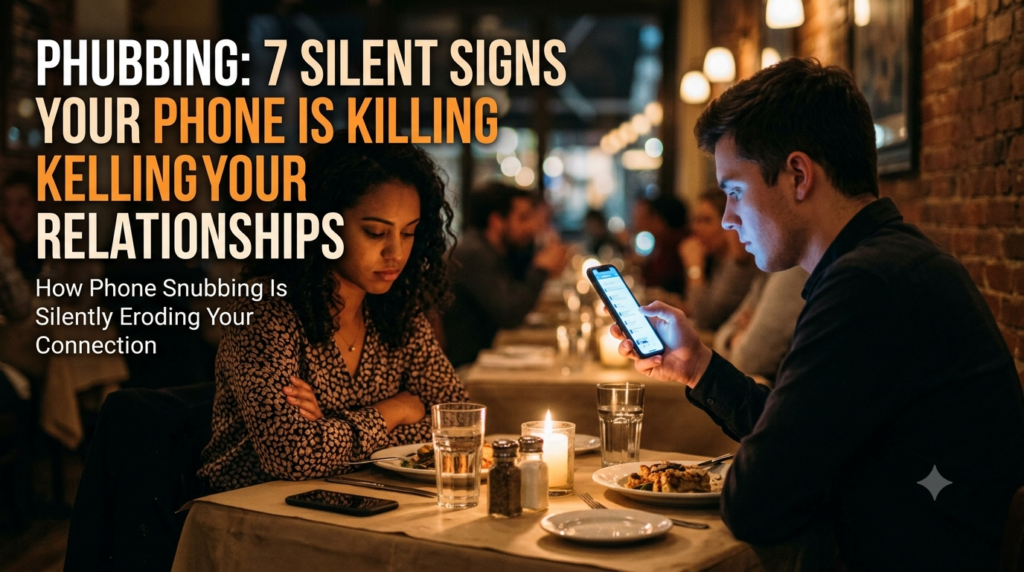
My Friends, ek scene imagine karo. Dinner table pe pati-patni baithe hain, thali saamne hai, aur ek partner phone mein WhatsApp status dekh raha hai jabki doosra apni din bhar ki baat share kar raha hai. Koi ladai nahi ho rahi, koi chillana nahi hai — bas ek chhota sa “hmm” aata hai screen ki taraf dekhte hue. Chhota sa moment lagta hai, na? Lekin science kehta hai ye chhoti si aadat relationships ko andar hi andar khokhla kar deti hai.
Iska ek naam hai — phubbing (“phone” + “snubbing”). Aur 2026 ki fresh research ne isse relationship science ke sabse consistent aur chinta badhane wale findings mein se ek bana diya hai. Aaj hum dekhenge phubbing kya hai, science kya kehti hai, aur Indian families/couples isko kaise fix kar sakte hain — practically, bina drama ke.
Table of Contents
1. What Is Phubbing?
Phubbing means attending to your phone instead of the person physically present with you — checking mid-conversation, scrolling during dinner, glancing at a screen while your partner or child is talking to you. The term was coined back in 2012 as part of a dictionary marketing campaign, but the behavior it describes has become one of the most researched relationship-damage patterns of the smartphone era.
It’s not just about romantic couples — parent-child phubbing, friend-group phubbing, and even phubbing during family gatherings all show similar damage patterns in research.
2. The Shocking Research Behind Phubbing
This is the part that genuinely surprised me, yaar. Foundational research by Roberts and David found that partner phubbing directly lowers relationship satisfaction, largely because it increases conflict specifically around phone use — creating a cycle where the phone itself becomes a recurring argument.
A newer 2026 University of Connecticut study found that phubbing — especially during high-stress periods — measurably reduces feelings of closeness and increases conflict between partners, and interestingly, this happened even when both partners used their phones equally often. In other words, it’s not really about how much you use your phone overall — it’s specifically about using it at the moment your partner needed your attention.
Even more revealing: a 2025 study published in the Journal of Personality found that people with higher attachment anxiety or insecurity are hit noticeably harder by being phubbed than emotionally secure partners — meaning the same small act of checking your phone can feel like a minor distraction to one person and a genuine emotional wound to another.
Researchers analyzing decades of relationship-bids data have also pointed to something called “turn-toward” rates — how often you turn toward your partner when they reach out for connection. Healthy relationships tend to sit around 86% turn-toward; struggling ones drop toward roughly a third. A phone in hand during couple-time is, in the words of researchers, essentially a machine for pulling that number down.
3. Why Even “Innocent” Phubbing Hurts
Here’s the psychology, simplified: every time someone shares a thought, a story, or just wants eye contact, it’s what relationship researchers call a “bid for connection.” When you glance at your phone instead of responding, you’re not just missing a sentence — you’re unconsciously answering the real underlying question (“are you here with me?”) with a no.
Do it once, no big deal. Do it repeatedly across months and years, and the cumulative message becomes: whatever is on that screen matters more than this person in front of me. Nobody says this out loud — but both partners feel it building.
4. 7 Signs You’re Being (or Being a) Phubber
- You check your phone within the first two minutes of sitting down for a meal together
- You give one-word answers while your eyes stay on the screen
- Your partner/child has said “put your phone down” more than once this week
- You scroll in bed instead of talking before sleep
- You feel a small flash of irritation when interrupted mid-scroll by a real conversation
- Family WhatsApp groups get faster replies than the person sitting next to you
- You’ve missed an important thing your partner or child said because you were mid-scroll
If even 2-3 of these feel familiar, phubbing has probably crept into your relationship — good news is, it’s completely fixable.
5. Phubbing in Indian Families and Marriages
Yahan India mein phubbing ka apna hi flavour hai. Joint family dinners mein sab log apne-apne phone mein busy, sasural mein rishtedaar baat kar rahe hain aur bahu ya beta reels dekh raha hai, ya phir pati-patni saath baithe hain lekin dono apne-apne Instagram mein doobe hain — ye sab bahut common scenes hain. WhatsApp family groups aur status updates aksar in-person conversation se zyada priority le lete hain, jaisa humne whatsapp-group-anxiety-digital-detox family aur office WhatsApp groups ki anxiety wale detailed post mein bhi discuss kiya tha.
Bachchon ke saamne phubbing ka asar aur bhi gehra hota hai — jab parents baar-baar phone mein busy rehte hain, bachche seekhte hain ki unki baat kam important hai, aur ye pattern aage chalke unke apne relationships mein bhi dikh sakta hai. Hamare <a href=”/digital-detox-for-families-india/”>Indian families ke liye digital detox guide</a> mein humne isi tarah ke ghar ke examples cover kiye the.
6. How to Stop Phubbing — Step-by-Step Fixes
Researchers are clear on one thing: repair here is structural, not moral. Guilt-tripping doesn’t work — building physical, visible boundaries does.
Step 1: Create one phone-free zone. Dining table is the easiest place to start. No phones on the table during meals — for anyone, no exceptions.
Step 2: Name the norm out loud. Simply telling your partner or family “main koshish kar raha hoon dinner ke time phone side rakhne ki” makes the boundary real instead of assumed.
Step 3: Acknowledge before you check. If you genuinely must check your phone, say so — “ek zaroori message hai, 30 second lagenge” — rather than silently disappearing into the screen. The research shows acknowledged interruptions hurt far less than silent ones.
Step 4: Turn off notifications during connection time. Our <a href=”/how-to-turn-off-phone-notifications-for-deep-focus/”>complete guide to turning off phone notifications</a> works just as well for protecting relationship time as it does for work focus.
Step 5: Make the phone’s location a decision. Charging the phone in another room during dinner or before bed removes the temptation entirely rather than relying on willpower in the moment.
Step 6: Watch for the insecure-partner effect. If your partner reacts more strongly to phubbing than you’d expect, research suggests this may connect to deeper attachment needs — worth a gentle, non-defensive conversation rather than dismissing it as “overreacting.”
7. A Personal Note from my side
Ek baar meri wife ne mujhe bataya ki main dinner ke time bhi phone check karta rehta hoon, aur sach kahu toh mujhe pehle laga ye normal hai — sab toh yahi karte hain! Lekin jab maine socha ki main kitni baar uski baat aadhi sun ke “hmm” bol deta tha, thoda bura laga. Humne ek chhota sa rule banaya — dinner table pe koi phone nahi, bas. Pehle 2-3 din thoda ajeeb laga, lekin ab conversations genuinely better feel hoti hain. Try karo yaar, chhota sa step hai lekin farak bada hai.
8. FAQ
Q1: What exactly is phubbing? Phubbing is a blend of “phone” and “snubbing” — it means attending to your phone instead of the person physically present with you, such as checking messages mid-conversation or scrolling during a meal together.
Q2: Does phubbing really damage relationships, or is it harmless? Multiple studies, including foundational research by Roberts and David and newer 2026 findings, consistently link partner phubbing to lower relationship satisfaction, increased conflict, and reduced feelings of closeness — even when both partners use their phones equally.
Q3: Why does phubbing hurt some people more than others? Research published in the Journal of Personality found that people with higher attachment insecurity experience noticeably stronger negative reactions to being phubbed compared to more securely attached partners.
Q4: How can couples or families reduce phubbing without constant arguments? Structural fixes work better than guilt trips — creating phone-free zones (like the dining table), naming the boundary out loud, acknowledging interruptions instead of silently checking, and charging phones in another room during connection time.
Q5: Is phubbing only a problem between romantic partners? No — research also documents parent-child phubbing and its effects on adolescent wellbeing, and the same patterns show up in friendships and joint family settings, especially common in Indian households with shared meals and family WhatsApp groups.