
Introduction
Table of Contents
In this post I’ll walk you through exactly what happens to your Brain after 7 Days of No Social media based on real science, not guesswork.”What if I told you that just 7 days without Instagram, YouTube, and WhatsApp scrolling could genuinely change your brain?
Not metaphorically. Not as a motivational quote. But literally — measurable, scientific changes in how your brain functions, feels, and focuses.
In 2026, social media addiction is no longer just a personal problem. It’s a public health crisis. Research published this year shows that heavy social media use causes measurable cognitive decline — declines in attention, memory, and executive function that in some studies resemble accelerated aging.
But here’s the hopeful part: the same research shows the brain can recover — and it starts recovering faster than you’d think.
In this post, I’ll walk you through exactly what happens to your brain on each day of a 7-day social media detox — based on real science, not guesswork. By the end, you might just want to delete Instagram tonight.
Let’s go.
First — What Does Social Media Actually Do to Your Brain?
Before we talk about what happens when you STOP, let’s understand what’s happening when you scroll.
Every time you get a like, a comment, a funny reel, or a surprising notification — your brain releases dopamine. Dopamine is the brain’s reward chemical — the same one triggered by food, music, and physical affection.
Social media platforms are deliberately engineered by PhD-level behavioural scientists to trigger dopamine as frequently and unpredictably as possible. This unpredictability is key — it’s the same psychological mechanism that makes gambling addictive.
Over time, your brain adapts. It starts needing MORE stimulation to feel the same reward. Regular life — studying, conversations, nature, books — starts feeling boring and unstimulating by comparison. This is called dopamine dysregulation — and it’s why you feel restless, bored, and anxious when your phone isn’t in your hand.
A 2026 study found that users who deactivated their social media apps for just 7 days reported a remarkable 42% improvement in their ability to complete complex tasks without interruption.
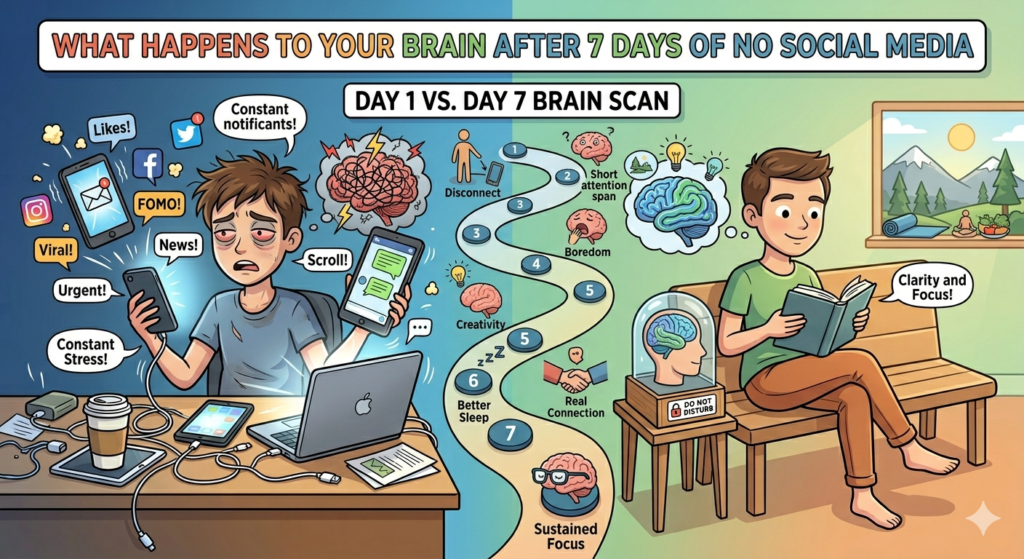
Now let’s see what happens day by day. (Brain After 7 Days of No Social Media)
Day 1 — The Urge is Real (And That’s Normal)
The first day is the hardest. Your brain is so used to the dopamine hits from social media that removing them creates a genuine withdrawal response.
You’ll feel:
- A strong, almost physical urge to check your phone
- Restlessness and boredom — especially during quiet moments
- A vague anxiety — like you’re missing something important
- Your hand reaching for your phone out of pure reflex
This is not weakness. This is your brain’s reward system reacting to the absence of its usual stimulant. Research confirms this is a genuine neurological response — similar in mechanism (though far milder in intensity) to other addiction withdrawals.
What’s actually happening in your brain: Your dopamine receptors are firing in anticipation of a reward that isn’t coming. The discomfort you feel is your brain recalibrating.
What to do: Acknowledge the urge, don’t fight it with willpower. Just delay it — tell yourself “I’ll check in 10 minutes” and then don’t. Do this repeatedly. Each successful delay weakens the neural pathway.
Day 2 — The Boredom Peak
Day 2 is often worse than Day 1 in terms of boredom. Without the constant stimulation of infinite scroll, your brain genuinely doesn’t know what to do with itself.
You might find yourself:
- Staring at walls
- Opening and closing apps repeatedly
- Feeling oddly irritable for no clear reason
- Struggling to focus on anything for more than a few minutes
But here’s what’s actually happening beneath the surface — your brain is starting to rest.
The prefrontal cortex — responsible for deep thinking, decision-making, and focus — has been chronically overstimulated by social media. It’s like a muscle that’s been exercising without a break. Day 2 is when it finally gets to stop and breathe.
Tip for Day 2: Fill the silence with something physical — a walk, cooking, cleaning, anything that uses your body. Your brain needs a gentle transition, not another screen.
Day 3 — Something Shifts
By Day 3, most people notice a subtle but real shift. The intense urges start reducing. The boredom starts feeling less unbearable.
Research on the “3 Day Effect” — originally studied in nature immersion contexts — shows that three days of reduced digital stimulation can meaningfully improve cognitive function, creativity, and problem-solving ability.
You may start noticing:
- Conversations feel more interesting
- Food tastes better
- Music sounds richer
- Small things — a sunset, a cup of chai — feel more enjoyable
This is your dopamine system beginning to recalibrate. When you remove artificial dopamine triggers, natural rewards start feeling rewarding again. This is the beginning of what researchers call dopamine reset.
Day 4 — Sleep Gets Better
By Day 4, one of the most reported benefits starts showing up clearly — better sleep.
Social media affects sleep in two ways. First, the blue light from screens suppresses melatonin — the hormone that makes you sleepy. Second, and more importantly, the emotional stimulation of social media — the outrage, the comparison, the FOMO — keeps your nervous system in a low-level state of alert that makes it hard to wind down.
Without social media, your evenings become calmer. Your nervous system starts settling earlier. People typically report falling asleep faster, sleeping more deeply, and waking up feeling more refreshed.
A 2026 research study on nighttime screen use and sleep quality confirmed that reducing social media use — particularly in the evening hours — significantly improves sleep quality among young adults.
Better sleep means better memory consolidation, better emotional regulation, and better focus the next day. Everything is connected.
Day 5 — Focus Returns
By Day 5, something genuinely exciting starts happening — your ability to focus starts coming back.
Social media is essentially a training program for distraction. Every 30-second reel, every notification, every infinite scroll teaches your brain to expect constant context-switching. Over time your attention span shrinks, making it harder to read long articles, study for extended periods, or finish tasks without interruption.
By Day 5 of no social media, users consistently report:
- Being able to read longer without losing focus
- Completing tasks from start to finish without checking their phone
- Feeling “in the zone” for the first time in months
- Less mind-wandering during conversations
This is your prefrontal cortex recovering its capacity for sustained attention. The neural pathways that support deep focus — weakened by months of social media use — are starting to strengthen again.
Day 6 — Anxiety Drops Noticeably
One of the most powerful changes people report by Day 6 is a significant reduction in background anxiety.
Most social media users don’t realise how much anxiety their feed is generating until they step away from it. The constant comparison with others’ highlight reels, the politically charged news, the fear of missing out, the pressure to post and be validated — all of this creates a chronic, low-grade anxiety that becomes so familiar it starts feeling normal.
By Day 6 without social media, that noise goes quiet.
Research has consistently shown a direct link between social media use and anxiety — particularly among young adults. A major 2026 study on digital addiction found significant positive correlations between screen addiction and anxiety symptoms.
Without the daily comparison triggers and outrage bait, your nervous system genuinely relaxes. You start feeling more comfortable in your own skin, less preoccupied with what others are doing, and more present in your own life.
Day 7 — Your Brain Has Measurably Changed
By Day 7, the changes are no longer subtle. They’re real, measurable, and felt deeply.
Here’s what research tells us happens after 7 days of social media abstinence:
Mental wellbeing increases significantly — A 7-day social media abstinence study found that participants experienced a significant increase in mental wellbeing and social connectedness, and a significant decrease in fear of missing out.
Focus improves by up to 42% — Users who deactivated social apps for 7 days report a 42% improvement in their ability to complete complex tasks without interruption.
Mood stabilises — Without the daily emotional rollercoaster of social media feeds, mood becomes more stable and consistent.
Real relationships feel deeper — Without the shallow substitute of social media connection, people invest more in face-to-face conversations and report feeling more genuinely connected to the people around them.
Self-esteem improves — Research on teenage girls found that even a 3-day break from social media improved self-esteem and reduced body shame. Imagine 7 days.
The Science Behind Why This Works So Fast
You might be wondering — how can 7 days make such a difference?
The answer lies in neuroplasticity — your brain’s remarkable ability to rewire itself based on experience. The same neuroplasticity that allowed social media to rewire your brain toward distraction and anxiety can rewire it back toward focus and calm — given the right input.
Your brain is not fixed. It is constantly changing based on what you feed it. And 7 days of feeding it silence, real experiences, and genuine connection — instead of infinite scroll and dopamine hits — is enough to begin measurable change.
A 2026 Washington Post report on social media detox research noted that even short breaks have proven effective for improving mental health — with results comparable to established therapeutic interventions.
What to Expect — Your 7-Day Brain Timeline
| Day | What You Feel | What’s Happening in Your Brain |
|---|---|---|
| Day 1 | Strong urges, restlessness | Dopamine receptors firing without reward |
| Day 2 | Peak boredom, irritability | Prefrontal cortex starting to rest |
| Day 3 | Subtle shift, small joys return | Dopamine system beginning to recalibrate |
| Day 4 | Better sleep, calmer evenings | Melatonin normalising, nervous system settling |
| Day 5 | Focus returning, tasks feel easier | Attention pathways strengthening |
| Day 6 | Anxiety noticeably reduced | Comparison and FOMO triggers removed |
| Day 7 | Clearer mind, better mood, deeper connections | Measurable neurological improvement |
Should You Quit Social Media Forever?
Not necessarily. The goal is not to live like a sadhu in a jungle. The goal is intentional use — using social media as a tool you control, not a habit that controls you.
After your 7-day reset, try these rules:
- No social media before 12 PM
- No social media after 9 PM
- Maximum 30 minutes per day — use a timer
- Delete apps from phone — access only on laptop
- Unfollow every account that makes you feel worse about yourself
Take the 7-Day Challenge
Yaar, you’ve read this far — which means some part of you already knows you need this.
So here’s my challenge to you: Start your 7-day social media detox today.
Not next Monday. Not after one last scroll. Today.
Delete Instagram. Delete YouTube. Put your phone face down. And come back in 7 days to tell me what changed.
Your brain is waiting to show you what it’s actually capable of — when you finally give it the silence it deserves. 💪