
Introduction
Be honest with yourself for a second.
Think about the last time your child sat down quietly — no fuss, no complaints, fully absorbed — for more than an hour. Chances are, they were watching YouTube. signs-child-addicted-to-youtube
Now think about the last time you asked them to put the phone or tablet down. What happened?
If the answer involves anger, begging, crying, or straight-up ignoring you — you are not alone, and you are not a bad parent. What you are facing is one of the most powerful psychological systems ever designed — and it was specifically engineered to hook your child’s developing brain.
In 2026, a landmark US court ruling found that both Meta and Google had deliberately designed addictive platforms that caused measurable psychological harm to young users. A jury awarded six million dollars in damages to a young woman who had started using YouTube at the age of six and had developed depression and self-harm behaviours by age ten. The court called it “engineering of addiction.”
Yaar, when the courts of America are calling out YouTube for engineering addiction in children — hum Indian parents ko toh double alert rehna chahiye.
This post will show you the 10 clear warning signs that your child is addicted to YouTube — and more importantly, give you a practical, fight-free action plan to help them without breaking your relationship with them.
Let’s get into it.
Table of Contents
Why YouTube Is So Addictive — The Science Behind It
Before we talk about signs, you need to understand WHY YouTube is so hard to resist — especially for children.
YouTube’s algorithm is not just recommending videos. It is a multi-billion-dollar psychological system designed by some of the world’s smartest engineers to maximise one thing: the amount of time your child spends on the platform.
It works through something called variable reward psychology — the same mechanism that makes slot machines so addictive. Every swipe, every new video is a pull of a lever. Sometimes the video is boring. Sometimes it’s the most entertaining thing your child has ever seen. The unpredictability is the trap. The brain releases dopamine in anticipation of the reward — and that dopamine hit keeps them coming back for “just one more video.”
For children, this effect is particularly dangerous. Adults have a developed prefrontal cortex — the part of the brain responsible for decision-making and self-control. Children’s brains are still developing. Features designed to hook adults are dramatically more powerful on young, developing minds.
YouTube Shorts has made this even worse. Short-form videos — 15 to 60 seconds each — condition a child’s brain to expect constant, rapid stimulation. After extended exposure to Shorts, longer content feels boring. Reading feels impossible. Sitting in a classroom for 45 minutes feels like torture. Sustained attention — the very skill your child needs for board exams, JEE, NEET, UPSC — becomes increasingly difficult to access.
Ek research study ne ye bhi confirm kiya hai — India mein 39% to 44% adolescents smartphone addiction se affected hain. Ye koi chhoti baat nahi hai.
Now — how do you know if YOUR child has crossed the line from normal YouTube use to addiction?
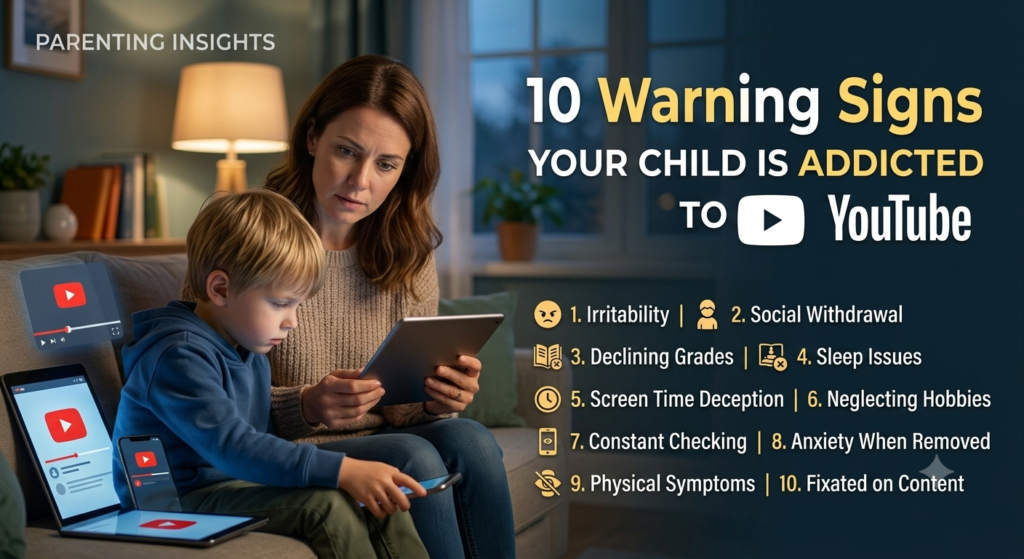
10 Warning Signs Your Child Is Addicted to YouTube
Researchers now use something called the YouTube Addiction Scale (YAS) — a tool developed from clinical addiction research — to identify six core patterns of problematic YouTube use: salience, mood modification, tolerance, withdrawal, conflict, and relapse.
Based on this scale and the latest 2026 research, here are the 10 real-world signs to watch for.
Sign 1 — They Watch for Hours Without Noticing Time
Your child sits down to “just watch one video” — and two hours disappear without them noticing.
This is called salience in addiction research — the activity takes over the mind so completely that normal time perception breaks down.
YouTube’s autoplay feature is specifically designed to create this effect. There is no natural stopping point. One video ends, another begins in 3 seconds — automatically. For a child without a developed prefrontal cortex, resisting autoplay is nearly impossible.
If your child regularly loses track of time on YouTube — if “5 minutes” consistently becomes 1-2 hours — this is the first warning sign.
Sign 2 — They Throw Tantrums When You Take the Phone Away
This is the most visible and most commonly reported sign by Indian parents.
Withdrawal symptoms. When a child is addicted to YouTube, taking away the device produces real, measurable distress — irritability, anger, crying, bargaining, even aggression. This is not just a bad mood. This is a neurological withdrawal response.
Research published in the American Journal of Preventive Medicine in 2026 specifically flagged “irritability when not online” as one of the core addiction-like behaviours in children aged 11-12.
Agar ghar mein phone lene par aisa lagta hai jaise earthquake aa gaya — yaar, yeh sign seriously lena chahiye.
Sign 3 — YouTube Is the First and Last Thing They Do Every Day
Does your child reach for their phone within minutes of waking up? Is YouTube the last thing they watch before sleeping?
This pattern — bookending the day with YouTube — is a strong indicator of psychological dependence. The platform has become a default emotional regulator. Their brain has been trained to start with a dopamine hit in the morning and wind down with YouTube at night.
The nighttime viewing is particularly harmful. Blue light from screens suppresses melatonin — the sleep hormone — delaying sleep onset and reducing sleep quality. A child who watches YouTube till midnight and then wakes at 6 AM for school is running on chronically disrupted sleep — which directly affects their mood, focus, and academic performance.
Sign 4 — Studies and Homework Are Constantly Suffering
If your child’s teachers are complaining about attention in class, if homework is incomplete, if board exam preparation is suffering — and YouTube is taking 3-5 hours of their day — these things are directly connected.
A child used to 15-second Shorts finds a 45-minute school lecture painfully slow. Their brain has been rewired to expect constant novelty. Sitting with one topic, going deeper, tolerating difficulty — these are the exact skills competitive exams like JEE, NEET, and UPSC require — and they are exactly the skills that excessive YouTube erodes.
Research from Indian pediatric studies confirms that screen time of more than 2 hours per day is associated with attention deficits and poor academic performance in school-going children.
Ek JEE aspirant jiska phone 6-7 ghante YouTube par jaata hai — uski padhai ka kya hoga, yeh sochne ki zaroorat nahi hai.
Sign 5 — They Are Withdrawing from Family and Friends
Social withdrawal is a classic addiction sign — and YouTube addiction is no different.
If your child is:
- Eating meals alone watching YouTube instead of with the family
- Avoiding family outings because they’d rather stay home and watch videos
- Losing interest in friendships that don’t involve screen time
- Preferring to be alone with their device over any social activity
…these are serious warning signs. Real human connection — the kind that happens at the dinner table, at carrom board, during chai time — is being replaced by parasocial relationships with YouTubers.
Sign 6 — They Talk About YouTubers Like Real Friends
Does your child talk about their favourite YouTuber the way they used to talk about their actual friends? Do they get upset when a YouTuber posts less frequently? Do they feel like they know these creators personally?
This is called a parasocial relationship — a one-sided emotional bond with a media figure. It’s normal in small doses. It becomes a problem when the parasocial relationship starts replacing real friendships and becomes a primary source of emotional connection.
Researchers identify this as “salience” — when YouTube thinking dominates the child’s mental space even when they are not watching. If your child talks about YouTube content, references YouTubers in unrelated conversations, or seems more emotionally invested in online creators than in family members — pay attention.
Sign 7 — Sleep Is Getting Worse
Late-night YouTube viewing destroys sleep quality in two ways — through blue light suppression of melatonin, and through emotional stimulation that keeps the brain alert long after the screen goes off.
Warning signs to watch for:
- Child is hard to wake up in the morning
- Complains of tiredness during the day
- Is irritable and moody throughout the day despite no obvious reason
- Falls asleep in class
- Has developed the habit of watching YouTube after you think they’re sleeping
Poor sleep in children is not just tiredness. It directly impacts memory consolidation, emotional regulation, immune function, and growth. As we covered in our post on how screen addiction affects sleep, sleep deprivation also dramatically worsens anxiety and mood disorders.
Sign 8 — They Secretly Watch Even After Being Told to Stop
Lying. Hiding devices. Watching under the blanket after lights out. Clearing browser history. Using a second phone or tablet that parents don’t know about.
This is the relapse component of the YouTube Addiction Scale — the inability to cut back even when the person is trying to, and the deceptive behaviours that follow.
When a child starts lying to you about screen time — yaar, yeh ek serious boundary cross ho gayi hai. This is not normal boundary-testing behaviour. This is compulsive behaviour driven by a genuine psychological need.
Sign 9 — Real-Life Activities Have Lost All Interest
Cricket in the gali. Carrom with the neighbours. Drawing. Cycling. Playing with younger siblings. Reading comics. Helping in the kitchen.
If activities your child used to love have been quietly abandoned — replaced entirely by YouTube — this is called tolerance in addiction research. Normal pleasures no longer produce enough dopamine to compete with the intense stimulation of YouTube. Real life starts feeling slow, boring, and unstimulating by comparison.
This is one of the most heartbreaking signs for parents to notice — because they remember the curious, active child their son or daughter used to be. And they watch that child disappear into a screen.
Sign 10 — Their Mood Depends Entirely on Screen Time
Happy when watching. Irritable, bored, and restless when not.
If your child’s emotional baseline has shifted — if they seem genuinely unable to self-regulate without YouTube, if boredom is now unbearable for them, if every unscreened moment feels like punishment — this is mood modification dependence.
The child has lost the ability to manage their own emotions without the external stimulus of the screen. This is the core of what addiction researchers mean when they say a behaviour has become pathological.
The 5-Step Action Plan for Indian Parents
Okay, so yaar — agar tumne upar wale signs mein 3-4 apne ghar mein dekhe hain — toh ghabrao mat. Yeh situation manageable hai. Lakhs of Indian families are dealing with this right now.
Here is what actually works — based on research AND real-world experience.
Step 1 — Have the Conversation First (Not a Lecture — A Conversation)
The single biggest mistake parents make is going straight to confiscation without explanation. This creates a battle — not a solution.
Sit with your child — chai peete peete — and talk. Show them this article if you want. Explain what dopamine is. Explain that YouTube is designed like a slot machine. Treat them like someone intelligent enough to understand what’s happening to their brain.
Children who understand why limits are being set are dramatically more likely to cooperate than children who feel arbitrary rules are being imposed on them.
Step 2 — Set Clear Screen Time Rules — Together
The Indian Academy of Pediatrics recommends no more than 1-2 hours of recreational screen time per day for school-going children. For older teens, quality matters more than strict hours — but 4+ hours of YouTube Shorts daily is excessive by any measure.
Involve your child in setting the rules. “Kitna time theek lagta hai tujhe?” Ask them. Negotiate. Agree on a number together. Rules that children help create are rules they are more likely to follow.
Use built-in tools to enforce these limits — you can learn how in our complete guide on how to set screen time limits on Android and iPhone.
Step 3 — Create Phone-Free Zones and Times
Certain times and places should be screen-free — non-negotiably:
- Dining table — no phones during meals (this applies to parents too!)
- Bedroom after 9 PM — charge phones in the living room
- First 30 minutes after school — outdoor time or family time first
- During homework/study hours — phone in another room, not just face-down
The bedroom rule is especially important. Children who charge their phones outside their bedroom sleep significantly better — and the temptation for midnight viewing is completely eliminated.
Step 4 — Replace, Don’t Just Remove
Here is the hardest truth about breaking any addiction: you cannot just remove the behaviour — you must replace it with something that also meets the underlying need.
Your child uses YouTube for stimulation, entertainment, social connection, and emotional regulation. If you take YouTube away without providing alternatives, withdrawal symptoms will be intense and cooperation will be near-zero.
Think about what your child used to love. Cricket? Art? Cooking? Music? Cycling? Chess? Rebuild those habits actively. Take them to the sabzi mandi. Teach them a card game. Enroll them in a sport. Restart family game nights with Ludo, Carrom, or Antakshari.
For more ideas, check out our post on how to spend your weekend without your phone — many of those ideas work perfectly for children too.
Step 5 — Model the Behaviour You Want to See
Yaar — yeh sab se important point hai. And yeh sab se hard bhi hai.
Children do not do what their parents say. They do what their parents do.
If you are on your phone at the dinner table — your child will be too. If you watch YouTube in bed — your child sees this as the norm. If you scroll Instagram while talking to them — they learn that screens are more important than people.
The most powerful intervention for YouTube addiction in children is a parent who is demonstrating healthy screen habits in their own life. Ek parent jo khud digital detox kar raha hai — uske bachche naturally follow karte hain.
For a structured approach to cutting your own screen time, try our 30-Day Digital Detox Challenge — do it as a family!
What NOT to Do — Common Mistakes Indian Parents Make
❌ Don’t confiscate the phone suddenly and permanently — this triggers intense withdrawal and breaks trust. Gradual reduction works better than cold turkey for most children.
❌ Don’t use YouTube as a reward or punishment tool — “finish your homework and you can watch YouTube” trains the brain to see YouTube as the ultimate prize worth any effort.
❌ Don’t shame or belittle your child — “tu toh addict ho gaya hai” said in anger will not help. It will damage their self-esteem and push the behaviour underground.
❌ Don’t install parental control apps without telling your child — secret surveillance destroys trust. Install them together, openly.
❌ Don’t have the conversation when you’re angry — wait until you are calm, and until your child is calm. Conversations that start with shouting end with doors slamming, not solutions.
Final Thoughts — A Word from One Indian to Another
Yaar, agar tum yeh post padhne tak aye ho — toh tumhara dil apne bachche ke liye kuch karna chahta hai. And that itself is everything.
YouTube addiction in children is not a parenting failure. It is a collision between developing human brains and billion-dollar psychological engineering systems. You did not create this problem. But you do have the power to address it.
The good news: children’s brains are extraordinarily neuroplastic — meaning they can and do rewire themselves when given the right environment. A child who is addicted to YouTube today can develop healthy tech habits with the right support, consistency, and love.
It won’t happen overnight. There will be fights. There will be setbacks. But every small step counts.
Apne bachche ka haath pakdo. Screen se zyada. ❤️
Put the right boundaries in place — not as a punishment — but as an act of love. Your child’s ability to sit with difficulty, sustain attention, feel boredom without panic, and build real human relationships — these are the skills that will carry them through JEE, through life, through everything that matters.
Those skills are worth fighting for.
Also Read
- How Screen Addiction Affects Your Sleep — And How to Fix It Tonight
- Can Too Much Screen Time Cause Anxiety? Science Finally Has the Answer
- Digital Detox for Students — How to Study Better With Less Phone
- 30-Day Digital Detox Challenge — Free Printable Tracker
- How to Set Screen Time Limits on Android and iPhone
- How to Spend Your Weekend Without Your Phone — 20 Ideas