
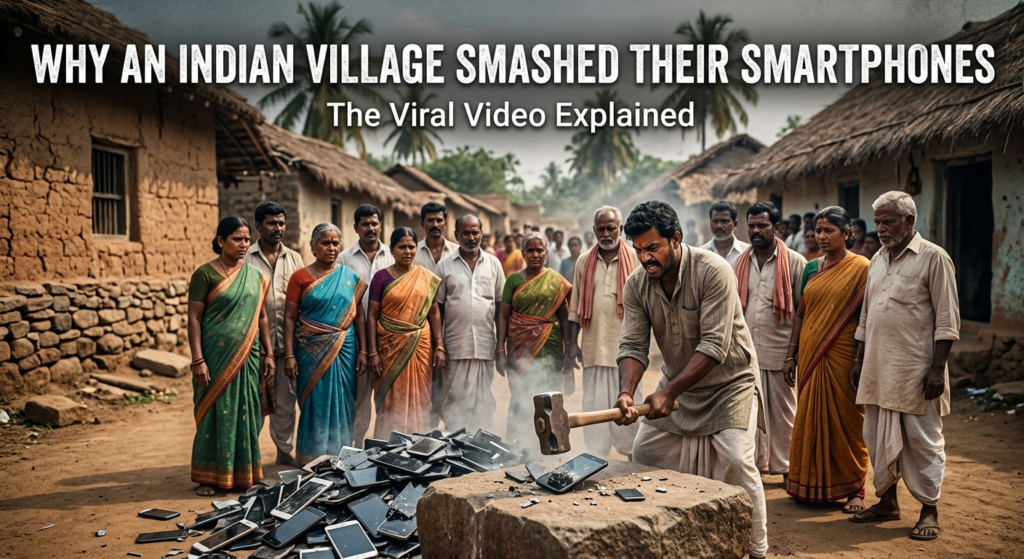
Oye Bhaiya, aapne bhi wo video dekha hoga jo pichle mahine social media pe chha gaya tha — ek gaon ke log ikattha hoke apne-apne smartphones ko patthar aur eenton se tod rahe hain. Video mein log naara laga rahe hain ki phone ek “nasha” ban gaya hai, aur ab wo phir se purana keypad phone use karenge. Video ko lakhon views mile, aur poori India mein bahas chhid gayi — kya ye ek bold, zaroori kadam tha, ya sirf ek extreme, impractical reaction?
Aaj hum is viral moment ke peeche ki poori kahani samjhenge, dekhenge India mein smartphone addiction ki real data kya kehti hai, aur sabse zaroori baat — bina apna ₹20,000 wala phone tode, hum apni digital habits kaise sudhaar sakte hain.
Table of Contents
1. What Actually Happened in the Viral Video?
In mid-June 2026, a video began circulating widely on X and other platforms showing a large group of villagers gathered in an open area, repeatedly hitting mobile phones with stones and bricks. According to the caption shared alongside the video, the community had decided to destroy their smartphones over growing concerns about mobile phone addiction, and said they planned to switch back to basic keypad phones instead. The footage quickly attracted millions of views and reactions, though the exact location and full context behind the decision remain unverified.
Reactions online split fairly sharply — some people praised the villagers for taking a visibly strong stand against excessive screen time, while others questioned whether physically destroying expensive smartphones was really a practical solution to what is, at its core, a behavioral problem.
2. Why Did This Video Strike Such a Nerve?
Whatever the full backstory, this video clearly touched something real. It’s not the first viral moment of its kind either — earlier this year, a video shared by industrialist Anand Mahindra showing an infant instinctively holding a rusk to their ear like a phone went viral for similar reasons, sparking half-joking, half-serious conversation about how deeply embedded phone habits have become across generations in India, even reaching infants who haven’t consciously chosen anything yet.
These moments resonate because most of us recognize the underlying feeling, even if we’d never actually smash our own phone — a nagging sense that the device meant to serve us has quietly started running the show instead.
3. The Real Data: Is Smartphone Addiction in India This Bad?
Here’s where the viral video connects to something genuinely well-documented. A 2024 study published in BMC Public Health, surveying 560 school-going adolescents aged 15-19 in Gujarat, found smartphone addiction prevalence at a striking 64.6% — nearly two out of every three teenagers studied showed signs of problematic smartphone use. The same study found smartphone addiction was strongly linked to severe stress, and that authoritarian or overly permissive parenting styles were associated with higher addiction rates, while a more balanced, authoritative parenting style was linked to lower rates.
Separate research from Delhi has even linked smartphone addiction among young adults to sedentary behavior and obesity risk, and the proportion of school-going children in India who own a smartphone has jumped from 36% to 61% in just the last two years, according to research from Gujarat. Put together, the viral video isn’t really an isolated overreaction — it’s a dramatic response to a pattern the data backs up almost everywhere researchers have looked.
4. Is Smashing Your Phone Actually a Good Idea?
Honestly, Oye Bhaiya? Probably not, and here’s why. Smartphone addiction, like other behavioral addictions, isn’t really about the object itself — it’s about the underlying habits, triggers, and reward loops that built up around it. Destroy the phone without addressing those, and in a connected, modern economy, most people will simply buy a new one within weeks, often falling right back into the same patterns, just with the added cost of a replacement device.
There’s also a real practical cost to consider — smartphones today handle banking, government services (UPI, Aadhaar-linked apps), work communication, and emergency contact for family. A dramatic, total break might make for a powerful video, but it isn’t a realistic or sustainable strategy for most people’s actual daily lives.
5. What Actually Works (Without the Drama)
Step 1: Address the underlying trigger, not just the device. If boredom, loneliness, or stress is what pulls you toward your phone, a fresh phone will fill that same gap right back up. Identify the actual trigger first.
Step 2: Try a structured, temporary detox instead of a permanent break. Our 24-hour digital detox challenge guide gives you a real taste of what the villagers were reaching for — reduced dependency — without needing to destroy anything or lose access to banking and emergency contacts.
Step 3: Switch specific habits, not the entire device. Deleting a handful of the most compulsive apps, turning off non-essential notifications, or using built-in screen time tools often achieves most of the same benefit with none of the downside.
Step 4: Get a real read on your own habits first. Before deciding anything drastic, our phone addiction self-assessment test gives you an honest, specific picture of where you actually stand, rather than reacting to a general feeling.
Step 5: Reset your reward system deliberately. Our dopamine detox guide for beginners targets the same underlying compulsive-use pattern the villagers were clearly frustrated with, in a way that’s sustainable long-term.
Step 6: Build one physical boundary at home. A simple household rule — phones stay in another room during meals or after a certain hour — recreates some of the intent behind the viral video (reclaiming physical space from the phone) without any of the impracticality.
6. Signs You Might Need Your Own “Reset Moment”
- You’ve had a genuine urge, even briefly, to “just get rid of” your phone entirely
- You reach for your phone the moment you feel bored, lonely, or anxious, without consciously deciding to
- You’ve noticed physical symptoms — restlessness, irritability — when separated from your phone for even short periods
- Your screen time has climbed noticeably over the past year without you actively deciding it should
- You’ve tried cutting back before and reverted within days
If several of these feel familiar, that’s a completely reasonable moment to start a structured, sustainable reset — no bricks required.
7. A Personal Note from Oyebhaiya
Jab maine ye video pehli baar dekha, mujhe samajh aaya ki logon ki frustration genuine hai — hum sab kabhi na kabhi feel karte hain ki phone control kar raha hai, hum nahi. Lekin sach kahu toh, meri khud ki journey mein jo cheez kaam aayi wo dramatic nahi thi — chhoti-chhoti habits change karna, jaise phone dusre kamre mein rakhna raat ko, ya specific apps delete karna. Video dekhke emotion samajh aata hai, lekin asli solution utna hi practical aur consistent hona chahiye jitna wo emotional hai.
8. FAQ
Q1: Did villagers really destroy their smartphones over addiction concerns? A viral video from June 2026 showed a group of villagers smashing smartphones with stones, with an accompanying caption claiming this was done due to smartphone addiction concerns, though the exact location and full context remain independently unverified.
Q2: Is smartphone addiction actually a serious problem in India? Yes, the data supports genuine concern — a 2024 study of 560 adolescents in Gujarat found smartphone addiction prevalence at 64.6%, strongly linked to severe stress, and smartphone ownership among Indian school-going children rose from 36% to 61% in just two years.
Q3: Is destroying your phone an effective way to overcome addiction? Not really — since addiction is driven by underlying habits and triggers rather than the device itself, most people would simply need to buy a replacement, often falling back into the same patterns without addressing the root cause.
Q4: What’s a more practical alternative to smashing your phone? A structured, temporary digital detox, deleting specific high-compulsion apps, disabling non-essential notifications, and creating physical boundaries like phone-free mealtimes tend to achieve similar benefits far more sustainably.
Q5: Are children in India increasingly at risk of smartphone addiction? Yes — research shows smartphone ownership among Indian school-going children rose sharply in just two years, and separate studies have linked heavy adolescent smartphone use to increased stress and, in young adults, sedentary behavior and obesity risk.
Also Read: If this viral moment got you thinking about your own habits, our 24-hour digital detox challenge guide, our phone addiction self-assessment test, and our dopamine detox guide for beginners are a much more sustainable place to start than a hammer.