
Table of Contents
Introduction
Let me ask you something honestly.
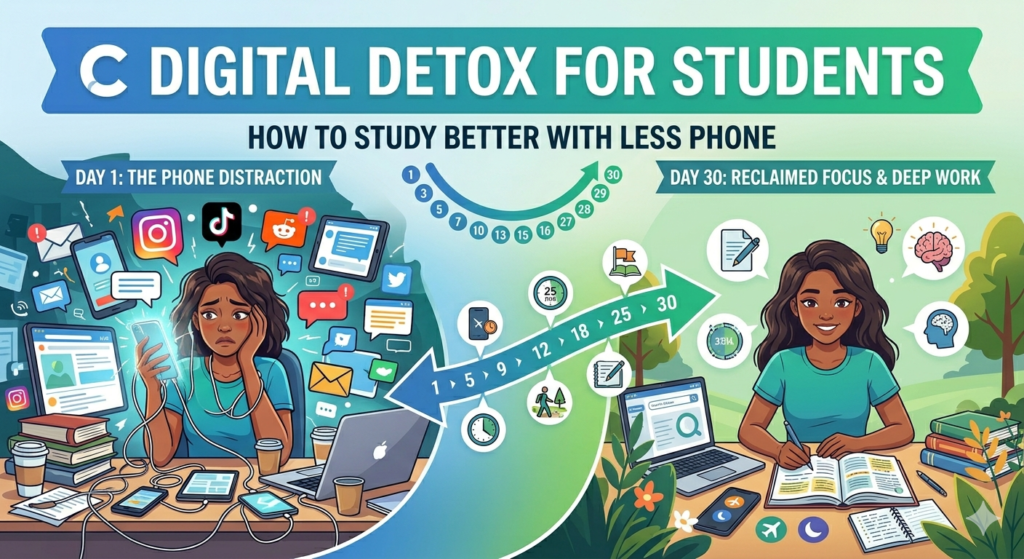
You sit down to study. You keep your phone “just nearby.” Within 10 minutes — one notification, one quick Instagram check, one YouTube “just this one video” — and suddenly 45 minutes are gone.
Sound familiar?
You are not lazy. You are not weak. You are a student in 2026 fighting against apps engineered by billion-dollar companies and PhD psychologists whose only job is to keep you hooked to your screen.
But here’s the truth nobody tells you: your phone is not just wasting your time — it is directly lowering your grades.
In this post, I’ll show you exactly how, and more importantly — I’ll give you a practical, step-by-step digital detox plan designed specifically for Indian students (Digital Detox for Students). Whether you’re preparing for JEE, NEET, board exams, or college assignments — this guide is for you.
Let’s get into it.
How Your Phone is Directly Killing Your Grades
Before we talk about solutions, let’s understand the problem with real data.
A research study tracking students found that the more they used their smartphones — even for so-called “educational purposes” — the lower their academic performance. More phone use directly correlated with lower grades. Not less. More.
Here’s why this happens. Every time you pick up your phone during a study session, your brain doesn’t just pause — it completely switches tracks. Research shows it takes up to 23 minutes to fully regain focus after just one phone interruption.
So if you check your phone 4 times in an hour of studying — you have essentially done zero deep studying in that hour. You were physically present at your desk but mentally absent.
This is called attention residue — your brain keeps thinking about what you saw on your phone even after you’ve put it down. Digital Detox for Students:
What Happens When Students Do a Digital Detox?
Here’s what the science says — and these numbers will shock you.
A Georgetown University study involving nearly 500 people who reduced their phone internet access for two weeks found remarkable results. Participants who averaged about 5 hours of screen time daily cut it down to approximately 2.5 hours. The results were extraordinary — improvements in mental health that researchers described as being in the same range as established treatments like cognitive behavioural therapy, and larger than the typical effect of antidepressants.
Students also slept 20 minutes more per night on average — and better sleep directly means better memory, better concentration, and better exam performance.
Another survey found that 47% of young people under 30 are now actively trying to reduce their screen time — this is a movement that the smartest students are already part of.
The question is: are you going to join them?
The Student Digital Detox Plan — 5 Simple Steps
You don’t need to throw your phone in a river. You just need a system. Here it is.
Step 1 — The “Phone in Another Room” Rule 📵
This is the single most powerful thing you can do — and it costs nothing.
When you sit down to study, put your phone in another room entirely. Not face down on your desk. Not in your bag. Another room.
Research consistently shows that even the mere presence of your phone on your desk — even face down, even switched off — reduces your available cognitive capacity. Your brain keeps a part of its attention reserved for the phone. Remove the phone, and that attention comes back to your studies.
How to do it:
- Keep a dedicated “phone spot” outside your study room — maybe the kitchen counter or your bed
- Put it on silent (not vibrate — vibrate is also a distraction)
- Tell your family you’ll be unreachable for the next 60-90 minutes
Start with just one study session per day with phone in another room. You’ll immediately feel the difference.
Step 2 — Study in 45-Minute Focused Blocks ⏱️
Your brain is not designed to focus for 3 hours straight. It is designed for focused bursts followed by short breaks — this is called the Pomodoro Technique and it’s used by top students worldwide.
The Student Pomodoro Method:
- 📚 Study for 45 minutes — phone in another room, complete focus
- ☕ Take a 10-minute break — you can check your phone NOW
- 📚 Study for another 45 minutes
- 🍽️ After 2 rounds — take a 20-30 minute longer break
This method works because you’re not fighting your phone urges forever — you know a break is coming. That makes it psychologically much easier to stay focused.
App to help: Use the Forest app to grow a virtual tree during your 45-minute sessions. If you open your phone — your tree dies. Simple, effective, and surprisingly motivating.
Step 3 — Delete These 3 Apps From Your Phone Right Now 🗑️
Not forever. Just during your exam preparation period or whenever you have important studies.
The three biggest study killers on every Indian student’s phone:
- Instagram — infinite scroll, reels, stories — designed to never end
- YouTube — one video becomes ten. Always.
- WhatsApp — group notifications every 2 minutes
How to do it without missing out:
- Delete Instagram and YouTube from your phone
- Access them only on your laptop — and only after your study goals for the day are complete
- For WhatsApp — mute all groups. Keep only personal important chats active
You won’t miss anything important. I promise.
Step 4 — Create a “Study Ritual” to Train Your Brain 🧠
Your brain learns through repetition and association. If you always study at the same time, same place, same setup — your brain starts automatically entering “focus mode” when you sit down.
Build your study ritual:
- Same time every day (morning works best for most students)
- Same spot — a dedicated study chair/desk
- Before starting: drink a glass of water, keep your notes ready, phone away
- First 5 minutes: review what you studied yesterday (this activates your brain)
- Then begin your 45-minute focused block
Within 2 weeks of following this ritual, you’ll notice your brain naturally shifts into focus mode much faster — because it recognises the routine.
Step 5 — The “Exam Mode” Weekend Digital Detox 📅
Once a week — ideally Saturday or Sunday — do a half-day complete digital detox.
From morning until 2pm — no phone, no laptop (unless needed for studies), no social media.
Use this time for:
- Deep revision of the week’s topics
- Solving practice papers without interruption
- Reading physical notes or books
Students who follow this weekly half-day detox report finishing in 4 focused hours what normally takes them 8 distracted hours. That’s the power of deep, uninterrupted focus.
Special Section: Digital Detox for Board Exam & Competitive Exam Students
If you are preparing for JEE, NEET, UPSC, SSC, or Board Exams — this section is specifically for you.
These exams require a level of deep conceptual understanding that is simply impossible to build through distracted study. Here’s your special plan:
3 months before exam:
- Maximum 1 hour of recreational phone use per day
- All social media deleted from phone
- Study 6 focused blocks of 45 minutes per day
1 month before exam:
- Maximum 30 minutes of phone use per day
- Only calls and essential messages
- Inform friends and family you’re in exam mode
1 week before exam:
- Phone used only for alarm and calling parents
- Complete news and social media blackout
- Focus entirely on revision
Top rankers in JEE and NEET consistently report that the last 30 days of focused, phone-free preparation made the biggest difference in their final score.
What To Do With Your Free Time (Instead of Scrolling)
One reason students fail at digital detox is they don’t replace phone time with anything meaningful — so boredom brings them back to scrolling.
Here are better alternatives:
- 📖 Read a physical book for 20 minutes — improves vocabulary and concentration
- 🚶 Take a 15-minute walk — proven to improve memory consolidation
- 😴 Take a 20-minute power nap — resets your brain for the next study session
- 📓 Write in a journal — process your thoughts without a screen
- 🧘 Try 10 minutes of meditation — apps like Headspace have offline modes
A Note for Parents Reading This
If you are a parent of a student — your role is crucial.
Research from Denmark found that when family members limited their own phone use to three hours a day, children’s anxiety and depression decreased significantly, and their overall wellbeing improved.
Your child watches you. If you are scrolling at the dinner table, they will too. The most powerful thing you can do is model healthy phone habits yourself.
Consider having a family rule: No phones at the dinner table. This one change alone can transform family conversations and reduce your child’s overall screen dependency.
Final Words
Beta, sun lo — your phone is the most powerful tool and the most dangerous distraction in your life right now. The students who learn to control it will go ahead. The ones who let it control them will keep wondering why they can’t focus.
You don’t need to be perfect. Start small. Put your phone in another room for just one study session today.
That one small step is where your digital detox begins. 💪
And remember — every topper you admire didn’t get there by watching reels. They got there by protecting their focus.