
Introduction
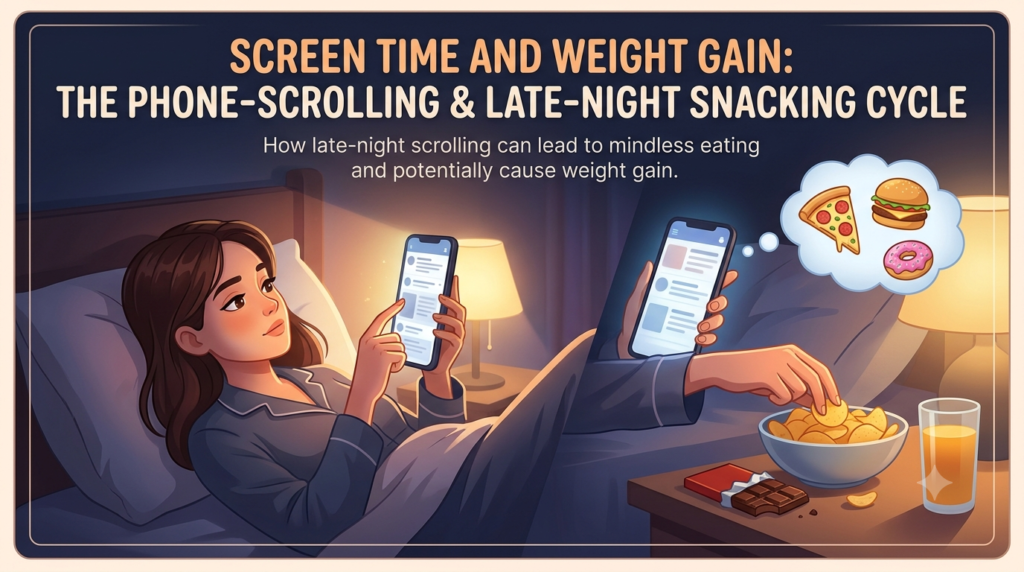
Yaar, sach batao — kitni baar aisa hua hai ki raat ko 11 baje bed pe lete lete Instagram reels dekhte dekhte achanak Swiggy khol li ho? Ek chips ka packet khatam ho gaya, pata hi nahi chala. Agle din scale pe khade hoke socha — “yeh weight kahan se aaya?”
Beta, you’re not alone. And no, it’s not just “lack of willpower.” There’s real science behind why your phone might be quietly adding kilos — not because of what you’re eating, but because of how your screen time is messing with your body’s signals.
So let’s answer the question seriously today: can screen time cause weight gain? Bilkul, and the reasons go much deeper than just “you sit and don’t move.”
Table of Contents
The Honest Question Most People Are Scared to Ask
Most articles on this topic talk only about kids and obesity stats. But this affects students preparing for JEE/NEET who sit 10 hours with phone nearby, young professionals doing WFH with laptop + phone combo, and parents who scroll while having dinner instead of being present.
If you’ve noticed your waistline creeping up since your screen time went up — chai pe baithe baithe, ya office ke baad couch pe phone leke leta hua — ye coincidence nahi hai. Let’s understand exactly why.
What Science Actually Says: Can Screen Time Cause Weight Gain?
This isn’t just “internet wisdom” — actual peer-reviewed research backs this up clearly.
A large systematic review and meta-analysis covering 44 separate studies found that increased screen time significantly raises the risk of overweight and obesity among adolescents, with risk climbing higher as screen hours increased — a clear dose-response relationship.
Closer to home, a 2026 study conducted in Pune, Maharashtra, evaluated nearly 4,000 urban Indian schoolchildren and adolescents and confirmed the same pattern in our own country — screen time was directly associated with overweight and obesity, even after accounting for diet and physical activity levels. This matters, beta, because often we assume “yeh sab foreign countries ki problem hai” — but the data clearly shows it’s happening right here in Indian cities too.
Another 2026 study published in Frontiers in Endocrinology found that children with cumulative screen time of 2 hours or more per day showed a notable increase in obesity risk. The researchers pointed to a simple but powerful reason: a large chunk of daily calorie intake happens while using screens — meaning we’re not just sitting still, we’re also eating more without realizing it.
The official guideline you’re probably ignoring
International health guidelines recommend limiting recreational screen time to under 2 hours per day for children and teens. Most of us — students aur professionals dono — are far beyond that. 5-7 hours of combined screen time is now considered normal in many households, which is exactly the range research flags as risky.
The Hidden Hormone Connection — Leptin, Ghrelin, and Your Phone
Ab yahan se baat thodi interesting (and important) ho jaati hai.
Your body has two key hormones that control hunger:
- Ghrelin — the “I’m hungry” hormone
- Leptin — the “I’m full, stop eating” hormone
Here’s the shocking part: a rigorous Harvard-affiliated clinical trial found that when people ate or stayed up later into the night, their leptin levels dropped significantly across a full 24-hour period, while their ghrelin-to-leptin ratio rose — meaning their bodies felt hungrier and less satisfied even though they hadn’t eaten more. Participants also burned calories at a slower rate when eating later, and their fat tissue showed gene activity favoring fat storage over fat burning.
Now connect the dots: where are most of us at 11 PM, 12 AM, 1 AM? Phone mein. Scrolling. And because we’re awake later, we often end up eating later too — triggering exactly this hormonal shift that makes us hungrier and stores fat more easily.
This is not “in your head.” Sleep researchers have also found that even short-term sleep restriction increases ghrelin levels, directly increasing hunger and food intake the next day. So the chain looks like this:
More screen time → later bedtime → poor/less sleep → hormone imbalance (more ghrelin, less leptin) → more hunger and slower fat burning → weight gain
Beta, isiliye sirf diet control karna kaafi nahi hai agar phone 2 baje raat tak chal raha hai.
Why Late-Night Scrolling Is Worse Than You Think
There are actually multiple separate mechanisms working together against you:
1. Distracted eating means more eating. Research shows that screen use can prolong eating duration and distract us from feeling full, so we keep eating past the point our body actually needed.
2. Food ads everywhere. Every second reel or YouTube ad is for Zomato, Swiggy, or some snack brand. Constant exposure to unhealthy food advertising while using screens has been shown to influence what we crave and choose to eat.
3. Blue light disrupts sleep, and poor sleep disrupts metabolism. The blue light from your phone screen can delay your body’s natural sleep onset and reduce sleep quality — and that poor sleep indirectly worsens weight-related metabolic changes.
4. Sitting is sitting, no matter how “harmless” it feels. Screen time is one of the most common forms of sedentary behavior — sitting or lying down while awake — and sedentary behavior is one of the strongest known contributors to unhealthy weight gain.
The Indian Context: Screens, Sedentary Lifestyle, and Our Changing Bodies
Hum Indians mein ye problem aur bhi tricky hai kyunki:
- Students: JEE/NEET/UPSC preparation often means 8-10 hours sitting + phone nearby for “quick breaks” that turn into 1-hour reels scrolling, often with chips or namkeen nearby.
- WhatsApp family groups: Late night “good night” forwards aur family group chats keep many of us up scrolling well past bedtime.
- Work-from-home professionals: Laptop screen all day + phone scrolling at night = almost 10+ hours of combined screen exposure, with minimal physical movement.
- Festivals and family gatherings: Often it’s screens + mithai + late nights together — a perfect storm for the exact hormone disruption we discussed above.
Ye apne aap weight badhne ka “mystery” nahi hai — pattern clearly samajh mein aata hai jab hum dekhte hain.
7 Practical Ways to Break the Screen-Weight Cycle
Chalo ab solution pe aate hain — kyunki sirf problem batana kaafi nahi hai.
1. Set a hard “screens off” time at night Try switching off all screens 60-90 minutes before sleep. Even just doing this 4-5 nights a week can help reset your leptin/ghrelin balance over a few weeks.
2. No phone during meals — period This single habit change reduces distracted, prolonged eating significantly. Keep phone in another room during breakfast, lunch, dinner.
3. Replace late-night scrolling with a “low light, low stimulation” wind-down Reading, light stretching, or just talking to family — anything that doesn’t involve a bright screen an hour before bed.
4. Move every 45-60 minutes If you’re a student or WFH professional sitting for hours, set a timer. Even a 2-minute walk around the room counters some sedentary effect.
5. Track your real screen time (not your guess) Most of us underestimate massively. Use your phone’s built-in Screen Time / Digital Wellbeing tool, or check out the free apps we covered in our best screen time tracking apps guide — seeing the real number is often the wake-up call you need.
6. Try a short digital detox to reset the pattern A focused reset — even our 30-Day Digital Detox Challenge — can help break the automatic “pick up phone when bored or hungry” loop.
7. Fix your sleep first, weight follows Since the hormone disruption is sleep-driven, prioritizing 7-8 hours of quality sleep does more for weight than most diet changes alone. If screens are wrecking your sleep specifically, our post on how screen addiction affects your sleep breaks down exactly how to fix it tonight.
A Personal Note from Me to You
Dosto, main khud is se guzra hoon. Raat ko phone leke lait jaana, “5 minute aur” karte karte 1 baj jaana, aur subah uthke socha — “yaar kal se pakka improve karunga.” Sabko hota hai ye.
But once I actually understood why this was happening — that it’s not just about willpower, it’s literally hormones and sleep getting disrupted — it became easier to take it seriously. Ek dum chhoti shuruaat karo: aaj raat se 30 minute pehle phone band karo. Bas itna hi. Baaki sab dheere dheere set ho jayega.
Tum kar sakte ho, beta. Ek kadam aaj, ek kadam kal. 💪